Free Shipping on All Scissors · Afterpay Available

Barber Scissor Size Guide: 5.0" to 7.0" Explained

Blade length changes everything about how a shear handles. Here is which size suits which technique, which hand, and which part of your day.

Blade length is the single most consequential decision a barber makes when buying a shear, and it is the one most often got wrong. Too short and your over-comb work fights you on every pass. Too long and your detail work around the ear feels clumsy. Get it right and the tool disappears into the work. This guide walks through the practical range from 5.0 to 7.0 inches, explains which length suits which technique and hand, and helps you build a kit that covers your whole day rather than just part of it.

How Barbers Measure Length

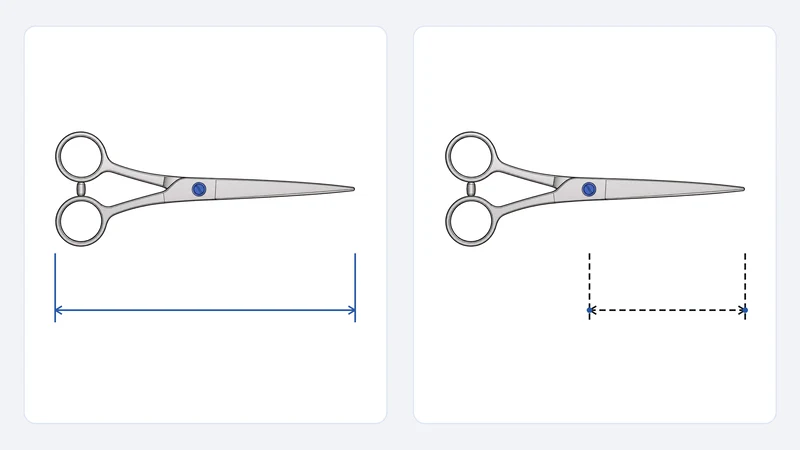
Scissor length is the overall measurement from the tip of the blade to the end of the longest finger ring, expressed in inches and usually in half-inch steps. A “6.5 inch” shear is not just a longer blade; it is a longer overall tool, which changes the reach, the balance, and how much hair you cover per stroke.

Two things matter here. First, half an inch makes a real, felt difference, so do not assume sizes are interchangeable. Second, your hand size interacts with length: a barber with larger hands generally carries a longer shear more comfortably, while a smaller hand often controls a shorter blade better. Length is personal, not just technical.

5.0 to 5.5 Inch: The Detail Specialist

The shortest barber-relevant lengths sit in the 5.0 to 5.5 inch range. These are nimble, precise tools built for close, intricate work. If you do a lot of fine detailing around the ears, sideburns, and neckline, or you have smaller hands that struggle to control a long blade, this is where comfort and precision live.

The trade-off is reach. A 5.5 inch shear is inefficient for sustained scissor-over-comb because it covers little hair per pass, so you make more strokes and your guideline is harder to keep straight. As a primary cutting shear for a busy barber it is usually too short, but as a dedicated finisher or for barbers whose work is genuinely detail-led it earns its place. Browse the 5.5 inch collection to see the precise end of the range.

6.0 Inch: The Versatile Middle Ground

The 6.0 inch shear is the great all-rounder, and for many barbers, especially those with average to smaller hands, it is the most natural everyday tool. It is long enough to handle moderate over-comb work without feeling stubby, yet short enough to stay controllable for finishing and detail.

If you are buying your first serious barber shear and you are unsure where you sit, 6.0 inch is the safest single-shear starting point. It does most jobs competently and few jobs badly. As your style settles you may add length or a shorter finisher, but a quality 6.0 inch rarely goes to waste. Explore the 6.0 inch collection for versatile everyday cutters.

6.5 Inch: The Barber Workhorse

If there is a single sweet spot for working barbers, it is 6.5 inches. This length is long enough to give confident, efficient scissor-over-comb and clipper-over-comb, covering plenty of hair per pass and keeping your guideline straight, yet still short enough to detail with reasonable control. It is the length I most often recommend as a barber’s primary shear.

For barbers with average to larger hands doing a typical mix of fades, tapers, and over-comb on short back and sides, 6.5 inch hits the balance point between reach and control better than anything else. If you are going to own one really good shear and your work is genuinely barbering rather than salon styling, this is the length to look at first. The 6.5 inch collection gathers the workhorse end of the range.

7.0 Inch: Reach, Authority, and Over-Comb

At 7.0 inches you move into proper over-comb authority. The extra length lets you span the comb’s spine and travel in long, confident strokes, finishing a panel in fewer passes. For barbers doing high-volume short back and sides, heavy bulk removal, or working taller clients where reach matters, a 7.0 inch shear is a genuine efficiency and wrist-preservation tool.

The trade-off is detail. A 7.0 inch blade is less forgiving in tight work around the ear and along a delicate neckline, and barbers with smaller hands can find it tiring to control all day. This is why many barbers run a 7.0 inch as a dedicated over-comb and bulk shear rather than as their only tool. Browse the 7.0 inch collection for the longest, most planted cutters.

Matching Length to Hand Size

Length is not chosen in a vacuum; your hand is half the equation. As a rough guide:

  • Smaller hands tend to control 5.5 to 6.0 inch shears most comfortably, and may find 7.0 inch tiring over a full day.
  • Average hands are well served across 6.0 to 6.5 inch, which is why these lengths are so popular.
  • Larger hands carry 6.5 to 7.0 inch comfortably and often prefer the reach and authority a longer blade gives.

If you can, hold a shear before you commit, or run our shear selection guide which maps length against technique and hand size to narrow the field. Comfort over a long day matters more than any spec on the box.

Building a Two-Shear Kit

Most experienced barbers do not rely on a single length, and for good reason. A common and highly effective setup is a longer primary paired with a shorter finisher:

  • A 6.5 or 7.0 inch primary handles your over-comb, bulk, and guideline work with reach and authority.
  • A 5.5 or 6.0 inch finisher takes over for necklines, sideburns, around the ear, and fine detail.

This division lets each tool do what it does best rather than compromising on a single length that is mediocre at everything. If you are building a kit over time, start with the primary that matches your most repeated technique, then add the finisher as your detail work demands.

A Sensible Buying Order

If you are early in your barbering and buying your first proper shear, here is the order I would suggest. Start with one well-balanced 6.5 inch shear if your work is genuinely barber-style, or a 6.0 inch if you do a more even mix of cutting and detail. Get comfortable, let your technique settle, and only then decide whether you need to add reach with a 7.0 inch or precision with a shorter finisher.

Do not over-buy on length before you know your style. A barber who buys a 7.0 inch first because it sounds impressive, then struggles with detail work, has spent money learning the wrong lesson. Length should follow technique, not the other way around.

The Short Version

Pick 5.5 inch for dedicated detail and smaller hands, 6.0 inch as a versatile everyday all-rounder, 6.5 inch as the barber workhorse sweet spot, and 7.0 inch for over-comb reach and bulk authority. Match the length to the technique you repeat most and the hand you actually have, and build toward a two-shear kit as your work grows. When you are ready to compare options side by side, run the shear selection guide to narrow the field by technique, hand size, and budget.