Why Are Professional Barber Scissors Expensive?
From forged steel to hand-finished edges, here is where the money goes in a premium barber shear, and when a cheaper pair is genuinely the smart call.
A pair of professional barber scissors can cost more than a week’s groceries, and to a new barber that feels absurd next to a $30 pair off the shelf. Yet barbers who have run both rarely go back. The price gap is not a brand tax invented to fleece you. It tracks real differences in material, manufacturing, and the way the tool holds up over years of daily cutting. This guide walks through where the money actually goes, and where it does not need to.
It Starts With the Steel
The single biggest cost driver is the alloy and how it is treated. Cheap scissors are typically stamped from soft, generic stainless that takes an edge poorly and loses it quickly. Premium shears use named cutlery steels chosen for a balance of hardness, edge retention, and corrosion resistance.
Harder steels hold a finer edge for far longer, but they cost more to source and are tougher to machine without cracking. The hardness rating (measured on the HRC scale) tells part of the story: an entry shear might sit around 58 HRC, while a premium convex barber shear can reach the low-to-mid 60s. That extra hardness is precisely what lets the edge stay keen through thousands of cuts. If you want the full breakdown of how alloys compare, our steel comparison guide sets it out grade by grade.
Forging vs Stamping
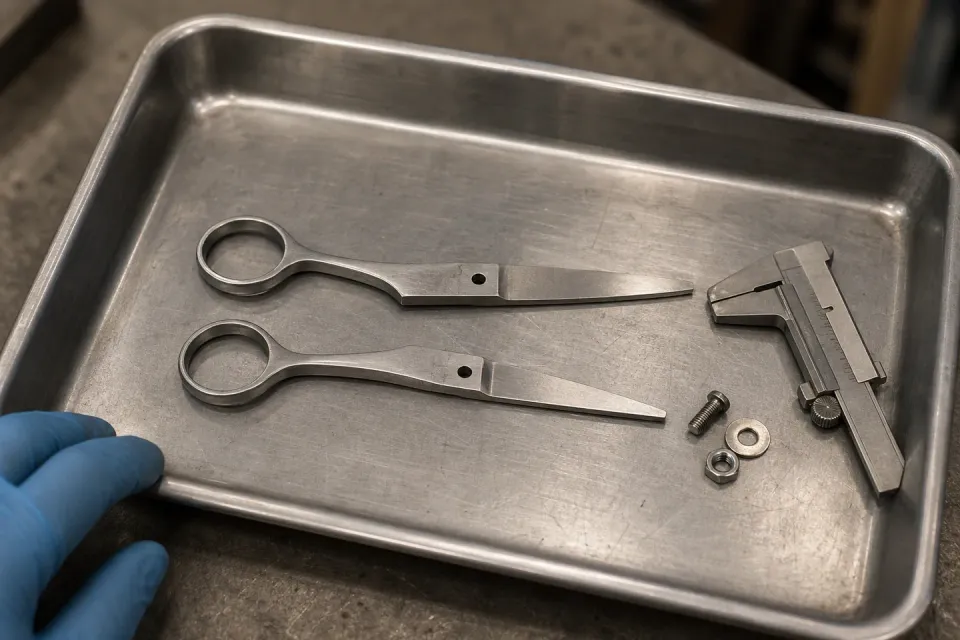
How the blade is formed matters as much as what it is made from. Budget scissors are usually stamped from sheet steel in one fast press. Premium shears are forged, where heated steel is shaped under pressure, producing a denser, more uniform grain structure. A forged blade holds its geometry better under tension and resists the micro-bending that throws cheap scissors out of true.
Forging is slower, more skilled, and wastes more material, all of which lands in the price. But it is the difference between a blade that stays true for a decade and one that goes vague after a few months.
Hand-Finishing Is the Hidden Cost
This is the part most people never see. On a quality shear, a craftsperson hand-hones the convex edge, sets the ride line where the blades meet, and balances the tension by feel. That ride line, the precise contact between the two blades along their length, is what gives a premium shear its clean, quiet, non-folding cut. It cannot be fully automated.
Hours of skilled labour go into each pair, and skilled labour is expensive everywhere, including the Japanese and German workshops where most professional shears originate. When a barber says a shear “feels alive,” they are feeling the result of that hand-finishing. A stamped, machine-ground edge simply cannot replicate it.
Ergonomics You Feel by Closing Time
Cheap scissors are usually one shape: even handles, dead balance, no thought given to the human holding them. Premium barber shears are designed around the hand and the repetitive strain of a full day in the chair.
Offset and crane handles drop the thumb into a neutral position, reducing the splay that wrecks wrists over the years. Carefully placed balance points keep the tips light during over-comb work. Adjustable tension lets you tune the cut to your hand. None of this is decorative. It is the reason barbers who switch to a well-designed shear often report their hand pain easing within weeks. That comfort is engineered in, and engineering costs money.
Edge Longevity and Serviceability
A premium shear is built to be sharpened and serviced for years rather than thrown away. The steel can take repeated professional honing without losing its profile. The pivot system is adjustable and often rebuildable. Brands stand behind these tools because they are designed to last.
A cheap shear, by contrast, is frequently not worth sharpening. The steel is too soft to hold the new edge, and the cost of professional sharpening can approach the cost of the scissors. It is effectively disposable, which feels cheap until you count how many you get through.
The Cost-Per-Cut Maths
Here is where expensive scissors quietly become the economical choice. Value is not the sticker price; it is the cost per cut over the tool’s life.
Take a $500 premium convex shear. Sharpened twice a year at roughly $60 a service, over a ten-year life that is around $1,700 all in. If you cut even 25 heads a week, that is roughly 13,000 cuts. The shear costs you about 13 cents per cut.
Now take a $40 budget shear. It dulls in a few months, is not worth sharpening, and gets replaced. Run through four a year and you spend $160 annually, $1,600 over a decade, for a tool that never cuts as cleanly and tires your hand the whole time. Worse, a dragging blade pushes hair instead of shearing it, which shows in your finishes and your reviews.
The premium tool wins on cost and on the quality of every cut in between. Browse the best sellers to see which shears barbers actually keep coming back to once they have done this maths.
When Cheaper Is Genuinely Fine
None of this means you must spend top dollar. There are sound reasons to buy mid-range or budget.
- Apprentices learning tension and technique are better served by a sturdy, affordable shear they will not be devastated to drop. Learn the craft, then upgrade.
- Backup shears that live in the drawer for the day your primary is at the sharpener do not need to be flagship pieces.
- Specialty or occasional use where you will not put the hours in to justify a premium edge.
- Genuine budget constraints. A solid sub-$200 shear in good steel will out-cut a no-name pair every time and is a sensible starting point.
The under $200 collection is built exactly for this: real cutlery steel and proper finishing at a price that suits apprentices, backups, and barbers building their first serious kit.
The Bottom Line
Professional barber scissors are expensive because forged premium steel, hand-finished edges, and genuine ergonomic design all cost real money to produce, and because they are built to cut cleanly for a decade rather than a season. For a full-time barber, the cost per cut almost always favours the better tool. For an apprentice or a backup, a well-chosen budget shear is the smart, honest call. Spend where the hours justify it, and the price stops feeling like a mystery.