Care for barber scissors
Wipe the blades dry after every client, oil the pivot at close and store the pair closed in a dry case. Check the tension once a week and book a sharpen when the pair folds hair at the right tension. Follow your maker's instructions where they differ, and your workplace hygiene process as well.
Dropped the pair, or does it catch or feel rough? Stop using it, switch to your backup and have it assessed.
Already own a pair? Daily habits →
The daily routine
- After each client: wipe dry. Wipe hair, water and product off both blades and around the pivot with a soft dry cloth. Moisture in the pivot is what rusts and stiffens scissors.
- At close: clean the pivot. Open the blades and clear hair from around the screw and where the blades meet.
- Oil the pivot. Open to 90 degrees, put one drop of scissor oil where the blades meet at the pivot, open and close a few times and wipe off the excess. In humid or coastal shops, add a drop at midday too.
- Store closed and dry. Close the blades and put the pair in its own slot in a dry case. Don't put a damp pair in a closed case.
- Weekly: check the tension. Hold the finger ring with the tips up, lift the thumb blade to 90 degrees and let go. This is one common method, and makers describe the target differently, so follow your maker's instructions for your model. Adjust in small steps.
- When hair folds at the right tension: book a sharpen. Don't keep tightening. Send it to a sharpener who works on convex Japanese edges.
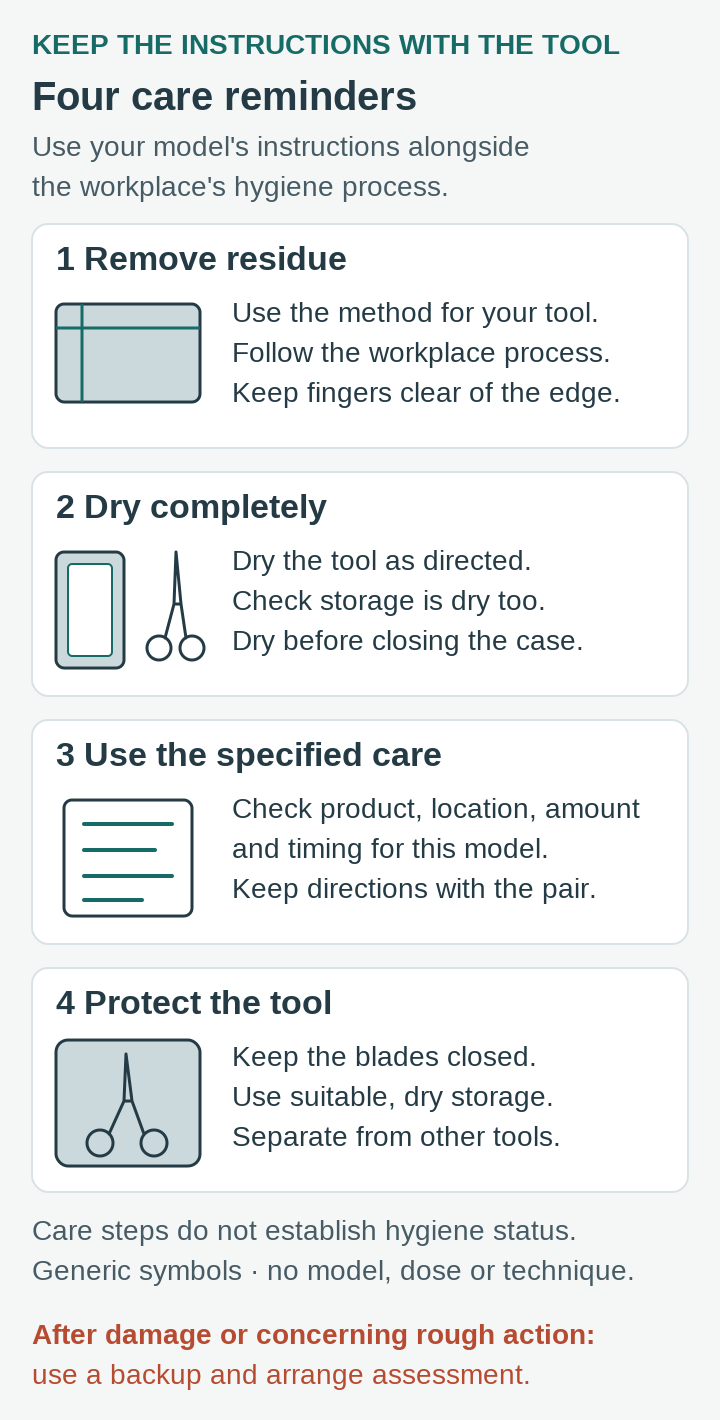
Four reminders, with the instructions nearby
-
Remove residue
Use the compatible method for your tool alongside the workplace process. Keep fingers clear of the cutting edge.
-
Dry completely
Dry the tool as directed and check its compartment separately. A closed case is a poor place to finish drying.
-
Use the specified care
Keep the model's product, application point, amount and timing together. Those instructions decide whether lubrication is due.
-
Protect the tool
Keep the blades closed in suitable, dry storage, separated from other tools. Check the case's fit and instructions too.
Open the labelled care reminders at full size
Find the instructions for this pair
Keep the brand, model, hand and length with the maker's care instructions. The full care routine has maker examples, and the pivot guide covers each tension screw type.
When cutting or movement changes
Pushing or folding hair: check the tension, clean and oil the pivot, then test again. The blunt shears guide walks through the checks. If it still folds, use the sharpening guide to choose a service.
Humid, coastal and tropical shops
Same routine, no skipped days, and dry the case as well as the scissors. The climate care guide covers each region.
Keep the record with the tool
Every care guide is in the care and servicing hub. Log sharpens and changes on the blank one-page service-history PDF or plain-text template.
Questions
How often should I oil my barber scissors?
Once a day at close, after cleaning and drying. In humid or coastal shops, add a drop at midday.
What oil should I use on barber scissors?
A light scissor or clipper oil, or the oil your maker supplies or names. One drop at the pivot is enough; wipe off the excess.
How do I know my scissor tension is right?
Hold the finger ring, tips up, lift the thumb blade to 90 degrees and let go. This is one common method, and makers describe the target differently, so follow your maker's instructions for your model. Snapping shut can mean loose; barely moving can mean tight.
Can I sharpen barber scissors at home?
Not a convex edge. Home sharpeners and flat stones can change the edge angle and the blade fit. Use a sharpener who works on convex Japanese edges.