10 Care Habits That Keep Barber Scissors Cutting
Quick answer
Ten habits keep barber scissors cutting: wipe after every client, set the shear down closed, dry it fully, put one drop of oil on the pivot at close, clear hair from the pivot, run the drop test weekly, look along the edges, keep the case dry, dry and oil more in humid weather, and sharpen on signs.
Scissor care is ten small habits, most of them under ten seconds. None of them is clever. Together they keep hair, moisture and knocks away from the two places a shear fails: the pivot and the edge.
How this list was chosen: these are the habits our care guides and the makers we link all agree on, ordered from the one you do after every client to the one you do when the shear tells you. Reviewed 4 November 2026. For the step-by-step version of the end-of-day routine, read how to clean and oil barber scissors.
The ten habits at a glance
Scroll sideways to compare all columns.
| # | Habit | When | It prevents |
|---|---|---|---|
| 1 | Wipe the blades | After every client | Dried-on hair and product |
| 2 | Set the shear down closed | Every time | Drops and bent tips |
| 3 | Dry it fully | Before it goes away | Rust and a stiff pivot |
| 4 | One drop of oil | At close | A rough, dry pivot |
| 5 | Clear the pivot | At close | Drag from packed hair |
| 6 | Drop test | Weekly | Loose or tight tension |
| 7 | Look along the edges | Weekly | Missed nicks |
| 8 | Keep the case dry | Weekly | A damp lining |
| 9 | Adjust for the weather | Seasonally | Moisture and salt |
| 10 | Sharpen on signs | When needed | Pushing on a dull edge |
1. Wipe the blades after every client
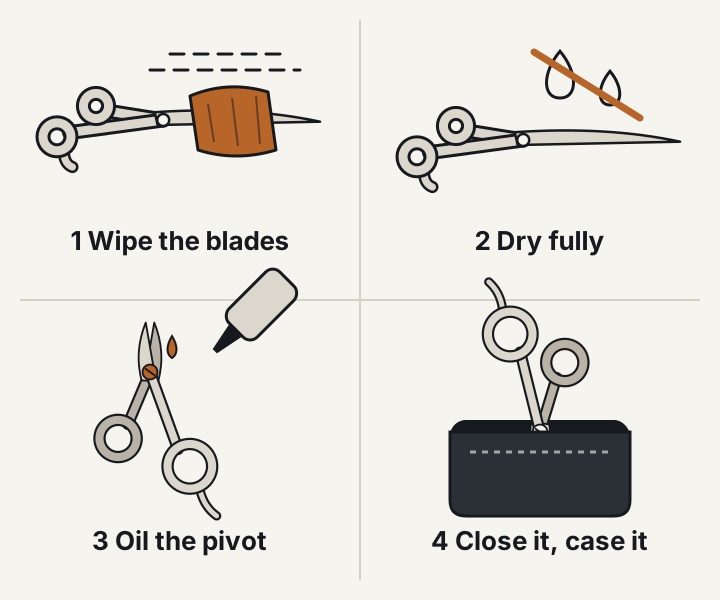
Open the shear and wipe each blade from the pivot out to the tip with a clean cloth. Keep the cloth on the flat of the blade and move away from the edge. This clears hair, water and product before they dry on.
A soft cloth is enough. Skip abrasive pads, which mark the steel and any coated finish. The black scissors list covers how coated finishes wear.
2. Set the shear down closed
Put the shear down closed, in the same place every time. A shear left open on the arm of a chair or the edge of a bench is one knock from the floor. A habit of setting it down in one spot also means you never hunt for it mid-cut.
A holder or holster at the chair does the same job. The cases and holsters guide compares them.
3. Dry it fully before it goes away
Dry the blades, the pivot area and the rings. Moisture left at the pivot is the problem, and a closed case traps it against the steel. This matters after a wet clean and after any disinfecting.
Never put a shear away damp, even for a short time.
4. Put one drop of oil on the pivot at close
With the blades open, put one drop of light scissor oil, or the oil your maker supplies, where the blades cross at the pivot. Open and close a few times to work it in, then wipe off the excess, including any on the blades.
One drop is the rule. More oil holds more hair. Jaguar’s care advice follows the same order: remove hair and residue after use, and dry thoroughly after cleaning.
5. Clear the pivot at close
Hair packs around the pivot screw and the base of the blades. Brush it out with the blades open, using a small soft brush. Do not pick at it with a blade or a pin.
A pivot that feels gritty after cleaning needs a closer look. The pivot systems guide explains what is underneath.
6. Run the drop test weekly
Hold the shear by the finger ring with the still blade level, lift the moving blade upright and let go. It should fall and stop part way. If it closes fully, the tension is loose. If it barely moves, it is tight.
Adjust in small steps with the maker’s adjuster. Do not take the pivot apart; it changes the tension setting and can damage the screw.
7. Look along the edges weekly
Open the shear under a bright light and look down each cutting edge. A fine line you can barely see is right. A shiny strip is a flattened edge, and bright points are nicks. Check that the tips meet evenly when closed.
Never run a finger along the edge to test it. The blunt scissors tests show safer checks.
8. Keep the case dry and clean
A damp lining makes a dry shear damp again. Let the case dry open, away from direct heat, and wipe the outside. Leather, felt and synthetic linings each have their own care, so do not use the steel cleaner on them.
If a case keeps coming up damp, move where it sits before you buy another. The maintenance guide covers storage.
9. Adjust for the weather
Humid and coastal shops need more drying and more frequent oiling. Salt on the steel comes from the air and from clients straight off the beach. A kit carried between the car and the door in the wet season needs a dry cloth and a dry pouch.
The climate care guide covers coastal, tropical and dry inland routines.
10. Sharpen on signs, not on a calendar
Care keeps an edge cutting; it cannot restore one. Book a sharpener when, after cleaning and setting tension, hair still pushes along the blade, the tips fold hair or the edge snags in one spot.
Keep a short log per shear. After two or three services your own interval is clear. How often to sharpen convex shears explains why signs beat a calendar, and the sharpening services guide lists what to ask a sharpener.
What would change this list
If you cut wet in a dry inland shop, habits 3 and 9 matter less and 7 and 10 matter more. If you work coastal or mobile, 3, 8 and 9 come first. When a shear is already misbehaving, run the drop test before you blame the edge.
Pick by career stage
- Apprentice: habits 1, 3 and 4. A cloth, a dry shear and one drop of oil at close.
- Working barber: habits 6, 7 and 10. Weekly checks and a log turn care into a schedule you can trust.
- Shop owner: habits 8 and 9. A dry case and a climate routine at every station.
Browse cases and accessories for storage, read the care guide for the short version, or start from the complete buying guide when it is time to replace a pair.
Further reading: for wider scissor background, see Scissorpedia. Scissorpedia is a fellow member of the ShearAlliance (see ShearAlliance).
The full set of care, climate and sharpening guides is in the knowledge base.
Questions
How often should barber scissors be oiled?
One drop at the pivot at the end of each working day, worked in with a few open-and-close strokes and wiped off. In a humid or coastal shop, oil more often. More oil does not help; it holds hair.
What is the drop test for scissor tension?
Hold the shear by the finger ring with the still blade level, lift the moving blade upright and let go. It should fall and stop part way. If it closes fully the tension is loose; if it barely moves it is tight.
Do I need to take scissors apart to clean them?
No. Clear hair from around the pivot with the blades open and leave stripping down to a sharpener. Taking the pivot apart changes the tension setting and can damage the screw.
When should I sharpen my barber scissors?
When they show signs, not on a calendar: hair pushing along the blade, tips that fold hair, a snag in one spot. Clean the pivot and check the tension first, since both cause the same symptoms.