10 Mistakes That Blunt a Pair of Barber Scissors
Quick answer
Barber scissors go blunt from small habits: tapping them on the station, dropping them, cutting paper or tape, storing them wet, leaving hair in the pivot, cranking the tension screw, soaking them in disinfectant, honing a convex edge on a flat stone, using the main pair for rough work and lending them out.
Most barber scissors do not wear out. They get knocked, wet, neglected or tightened until the edge gives up. Here are ten habits that blunt a pair, each with the one that replaces it.
How this list was chosen: these are the causes of edge damage that come up across care guidance and sharpening advice, ordered from the quickest damage to the slowest. Each has a fix you can apply at the chair. Reviewed 4 November 2026. If your pair is already misbehaving, start with the blunt scissors tests.
The ten mistakes at a glance
Scroll sideways to compare all columns.
| # | Mistake | Replace it with |
|---|---|---|
| 1 | Tapping the shear on the station | Wipe, then brush |
| 2 | Letting it fall | A holder, a case |
| 3 | Cutting anything but hair | A second pair for rough work |
| 4 | Putting it away wet | Dry, then oil, then case |
| 5 | Leaving hair in the pivot | Clear it daily |
| 6 | Cranking the tension screw | Drop test, small steps |
| 7 | Soaking in disinfectant | Wipe, then dry fully |
| 8 | Honing a convex edge at home | A specialist sharpener |
| 9 | Using the main pair for rough work | A backup pair |
| 10 | Lending the pair out | One pair, one hand |
1. Tapping the shear on the station
Shaking hair off by knocking the shear on the bench is the most common damage a shear takes. The tips are the finest part of the blade, and they meet the surface first. A small bend there changes how the tips close.
Wipe each blade from pivot to tip with a cloth instead. A soft brush clears hair from around the pivot. The cleaning guide has the full routine.
2. Letting it fall
A drop onto a hard floor can chip an edge, bend a tip or shift the blade alignment. A shear left open on the arm of a chair or the edge of a bench is a drop waiting to happen. If a pair falls, stop using it and have it checked before the next client.
Put the shear in a holder or closed in its slot every time you put it down. The cases and holsters guide compares the options.
3. Cutting anything but hair
Paper, tape, thread, cardboard and plastic wear a hair-cutting edge quickly. Cutting paper to test sharpness has the same effect, so do not do it. Keep one cheap pair for anything that is not hair.
To check an edge, use the wet tissue test in the blunt scissors guide instead.
4. Putting it away wet
A closed case traps moisture against the steel. Water at the pivot is what makes a shear stiff and rough, and a damp lining keeps a dry shear damp. Dry the blades, the pivot area and the rings before the shear goes in.
Dry first, then one drop of oil on the pivot, then case. In a humid shop, do it more often; the climate care guide covers coastal and wet-season routines.
5. Leaving hair in the pivot
Packed hair at the pivot adds drag and holds moisture. The blades then wear against hair and residue instead of against each other. A gritty open and close is the sign.
Open the blades to about 90° and clear around the pivot screw at the end of every day. The maintenance guide lists the routine, and a pair that still feels rough after cleaning needs a look.
6. Cranking the tension screw to fix folding
Hair folding is the symptom of a dull edge, but also of loose tension and residue. Tightening the screw to cure it hides the cause and wears the contact surfaces. Tension does not sharpen a blade.
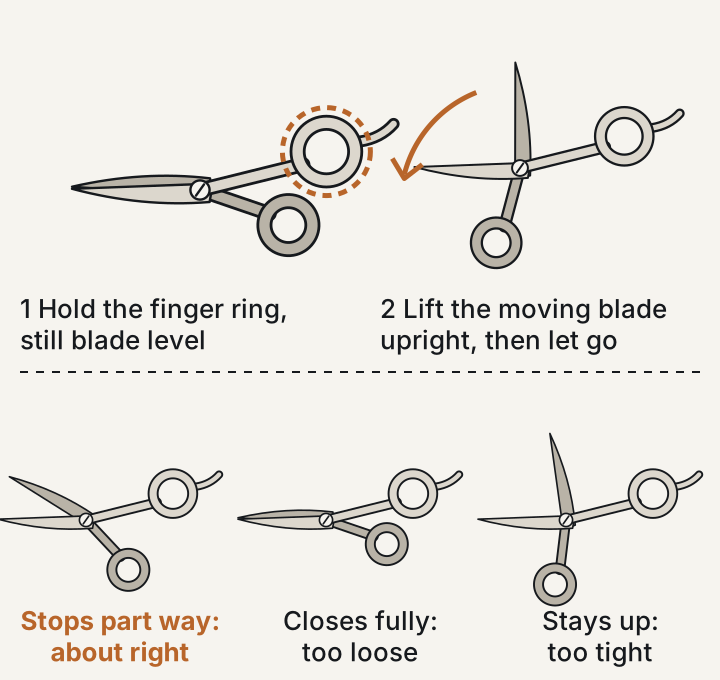
Run the drop test first, then adjust in small steps with the maker’s adjuster. The pivot systems guide explains the main adjuster types.
7. Soaking in disinfectant
Disinfectant left at the pivot stiffens it, and soaking is how it gets there. Follow your workplace hygiene process: wipe the shear clean first, use a disinfectant suitable for steel tools for the contact time it lists, then dry completely and oil the pivot.
Do not leave a shear soaking, and do not put it away damp afterwards.
8. Honing a convex edge at home
A convex edge curves from the spine all the way to the edge, with a slightly hollow inner face. A flat stone puts a facet on that curve and turns it into a bevel edge, which changes how the shear cuts. Home honing is a repair that is difficult to undo.
Leave the edge to a specialist and ask how they handle convex blades. The sharpening services guide lists what to ask, and how often to sharpen convex shears explains why signs beat a calendar.
9. Using the main pair for rough work
Dry-cutting thick hair, cutting wigs and extensions, or trimming product-laden hair puts extra wear on the pair you rely on. Rough work belongs with a second, cheaper cutter. That keeps the edge on your main pair for the cuts that show.
A backup also covers the days the main pair is away for service. The first kit guide shows where a second cutter fits.
10. Lending the pair out
Another barber’s grip and tension preference change how the shear sits and cuts. A pair set for your hand can come back loose, dropped or oiled with something else.
One pair, one barber. If a shared station needs shared tools, give those tools their own set and keep your main pair out of it.
What would change this list
If you cut dry all day, mistakes 3 and 9 matter most because dry cutting wears the edge faster than wet. If you work in a humid or coastal shop, 4, 5 and 7 come first. When a pair is already past saving by habit alone, book a service rather than adjusting the screw.
Pick by career stage
- Apprentice: mistakes 1, 2 and 4. A felt case, a cloth and a dry shear at close will carry you a long way.
- Working barber: mistakes 6, 8 and 9. Learn the drop test, find a convex-capable sharpener and keep a rough-work pair.
- Shop owner: mistake 10. Give every station its own pair and its own care kit.
Browse cases and accessories for storage, read the apprentice mistakes post for the first-month version of this list, and use the complete buying guide when a pair is past saving.
Care, sharpening and troubleshooting answers live together in the knowledge base.
Questions
What dulls barber scissors fastest?
Cutting anything but hair, and knocks to the tips. Paper, tape and thread wear an edge quickly, and a tap on the station or a drop can bend or chip a tip. Both are avoidable with one habit each.
Does tightening the tension screw sharpen scissors?
No. Tension controls how firmly the blades meet at the pivot. Too loose lets hair fold; too tight drags and wears the blades. If the shear still folds with the tension right, the edge needs a sharpener.
Can I sharpen convex scissors at home?
Leave it to a specialist. A convex edge curves from spine to edge, and a flat stone grinds a flat facet onto it, which turns it into a bevel. Ask any sharpener how they handle convex blades before you book.
How do I know the edge is the problem and not the tension?
Clean the pivot, run the drop test and set the tension, then cut a wet tissue along the blade. If it still folds or catches, the edge is dull or nicked. The blunt-scissors tests walk through four checks.