Barber Lingo, Decoded: Tools and Gear
What the shop words for scissors, toothed shears and technique usually mean, and the question to ask before you cut on one.
Quick answer
Most barber tool words are shop labels, not standards. Blender, thinner and texturiser overlap, a tooth count does not tell you how much a toothed shear removes, and phrases like knock the weight down need a follow-up question. Say the word, then say the length, the place and the result you mean.
Barber lingo is shop talk, and it shifts from shop to shop, school to school and catalogue to catalogue. Learn the common words below, then ask what the other person means before you cut on it. That one habit saves more bad haircuts than any new tool.
Key takeaways
- Shears and scissors are the same family of tool. Which word you use is habit, not a technical line.
- Toothed shears go by many names. Read the model’s own specs, not the label.
- Technique words like pointing, chipping, notching and sliding are not reliable synonyms. Describe the blade movement.
- Coaching phrases from the next chair are cues, not laws. Turn each into something you can see.
- Care habits are part of the culture: inspect, clean, dry, oil, store.
What do the scissor words actually mean?
Most scissor words are nicknames for a job, and two shops can use one nickname for two different tools. Here is the working list.
- Shears / scissors: the same family of tool. Preference varies by region and trade, and neither word is the correct one.
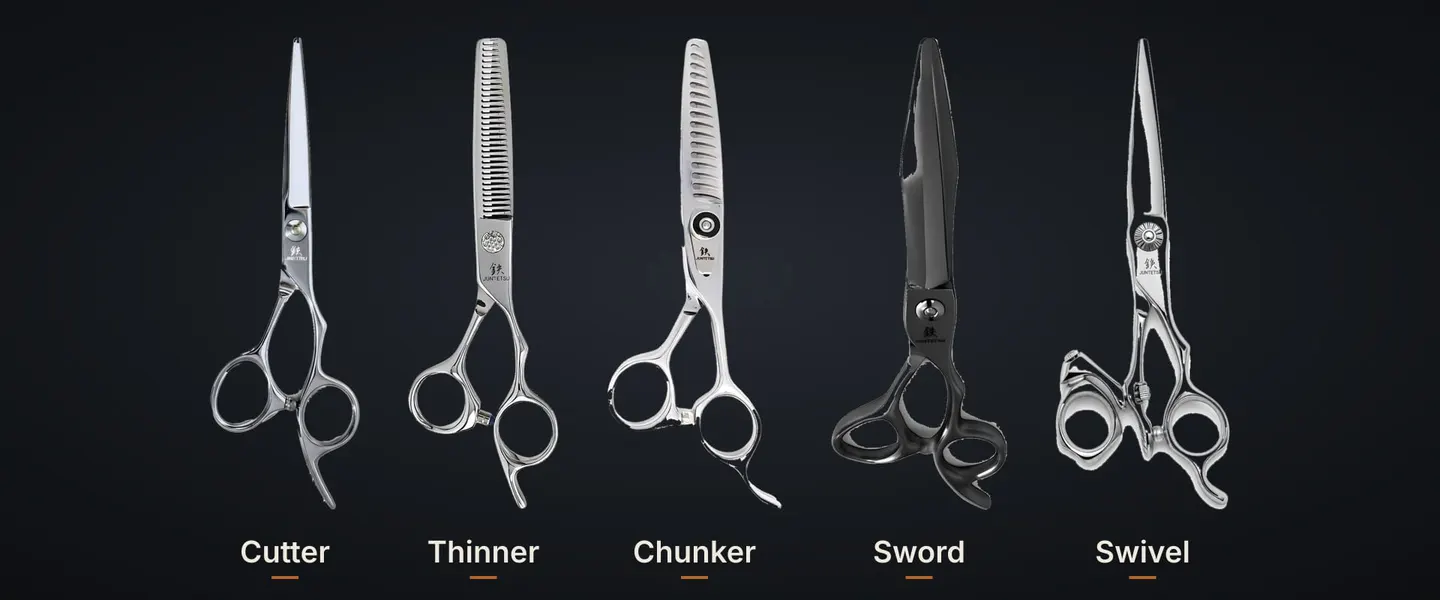
- Blender, thinner, texturiser, chunker: loose names for toothed shears. The names overlap, so go by what the specific model does. The thinners versus blenders guide sorts the roles.
- ”30s” and ”40s”: usually a tooth count. Count alone does not tell you removal: two shears with the same count can take very different amounts per close.
- Finisher, soft blender, transition shear: a role label for fine blending work. Check the teeth and the stated cut rate before you trust the name.
- Tang, hook, pinky rest: the small finger rest on the handle. The parts of barber scissors shows where it sits.
- Click tension: a notched, click-adjustable pivot. It tells you how the tension adjusts, not what the setting should be.
- Double-toothed: both blades carry teeth. “Feather shear” and “double-sided blender” are seller labels for the same idea.
- Sword or katana: a blade form, or just a series name. Look at the cross-section, not the word.
- Fade scissors: a retail or educator label. Inspect the blade, handle and the motion you will use the pair for.
- Detail, beard, moustache, brow scissors: purpose labels. Sizes overlap, so there is no single standard class.
Every term here has a one-sentence entry in the barber scissor glossary, and the ten terms list covers the specs that matter most when you read a listing.
Which clipper words get mixed in?
Guards, outliner and detailer belong to clipper talk, and nicknames for clipper models vary by shop. “Trimmer” can mean a small electric detailing tool in one shop and a different trimming tool in the next. If a colleague says “grab the trimmer”, check which one they mean.
What do the technique words mean?
Treat technique words as prompts to clarify. The same word can describe different blade movements, and two words can describe one movement.
Scroll sideways to compare all columns.
| Shop phrase | What it usually means | Ask |
|---|---|---|
| Blend out a line | Soften a visible transition | With which tool? |
| Knock down weight, open up | Reduce bulk or density | Where, and how much? |
| Break up the line, point into the ends | Soften a perimeter with the scissor tips | How deep do the bites go? |
| Chipping in, pointing, chop cut | Tip work; boundaries depend on the system | Which entry direction? |
| Notching, V-cuts | Larger, more visible bites | How deep? |
| Slide, glide, slither | Open blades travelling along hair | Direction, wet or dry? |
| Freehand, by eye | Working without a held guide | Any guide at all? |
| Disconnected | A deliberate break in length, not blended | Where does the break sit? |
| Cross-check | Inspect from another direction | Done after each section? |
| Chase the line | Follow a guide or remove a line | Follow it or remove it? |
Some schools treat point cutting and chipping as two moves, and others use “point cutting/chipping in” as one label. Some maker technique pages call the same movement a chop cut (point cut). All three are real, which is why the last column of the table asks a question. For how the main moves fit into a cut, see texturising technique for barbers.
Are those coaching phrases rules?
No. They are cues someone found useful, and each one points at something you can check. “Drop your elbow” is about posture. “Let the tool do the work” is about not forcing a blade that is not cutting, which is a cue to stop and check it. “Only the top blade moves” is about keeping the other blade still. “Never cut past the second knuckle” is about keeping fingers out of the blade’s path.
Translate the phrase into what you can see, then use it. Treat “never go near the scalp” the same way: it does not fit every texture or every design.
What is the culture around the tool itself?
Many barbers treat their main scissors as personal gear. Blade length, weight, finger position and form are chosen to suit one person, and switching tools changes technique, so plenty of barbers do not lend and borrow. That is a working practice, not a universal rule.
The care routine is the same everywhere:
- Inspect the blades and pivot.
- Clean them.
- Dry them.
- Oil the pivot as the maker advises.
- Store them in a case or pouch.
Disinfectant and contact time depend on the product and on your local requirements, so follow those and the maker’s instructions. The hygiene guide covers the between-client routine, and anything that needs the edge restored goes to a qualified professional sharpener.
Use the word, then say the result
When you give or take an instruction in the shop, finish it with the length, the place and the result. “Knock the weight down” becomes “take the weight out of the crown, keep the length”. The same habit works at the chair: the client consultation guide has scripts for the phrases clients use, and cut names explained does the same for taper, fade, crop, two-block and mullet. When you are choosing a toothed shear, how to read a barber scissor listing shows which spec lines to trust, and the thinning shears collection lists the models by tooth count.
More barber guides sit together in the knowledge base, and the barber scissor FAQ answers the questions people ask most.
Further reading: Scissorpedia is an information website and a fellow member of the ShearAlliance.
Questions
Is a blender the same as a thinner?
Not reliably. Both are names for toothed shears, and shops draw the line in different places. Go by the model's tooth count, tooth width and published cut rate, not the word on the shelf.
Does a higher tooth count mean it removes less hair?
Not across different models. Tooth width, spacing and construction change the result as much as the count. Strand-test a new toothed shear on a low-risk section before you use it on a client.
Is a scissor fade a different tool?
No. It is a label for a gradient built mostly or wholly with scissors, usually scissor-over-comb. Ask whether other finishing tools are allowed before you take the job or the brief.
Why do barbers not share scissors?
Fit is personal, and damage and hygiene add reasons. A pair is chosen for blade length, weight and finger position, so a borrowed pair changes your technique. It is a common practice, not a rule.