10 Barber Scissor Terms Explained
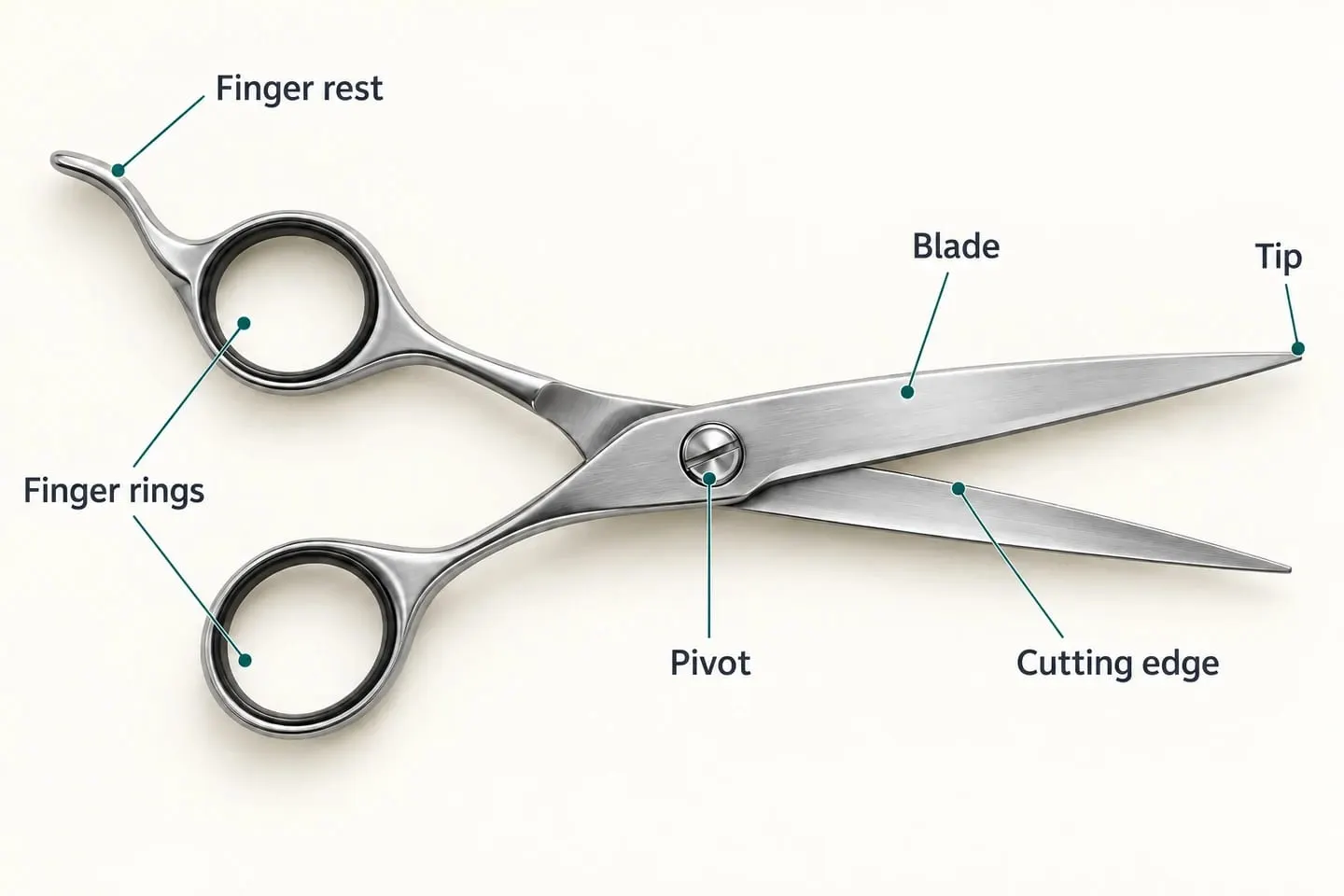 Illustration
Quick answer
Ten terms cover most barber scissor product pages: pivot and tension, whole-shear length, offset and classic handles, convex edge, bevel edge with micro-serration, sword blade, HRC, tooth count, scissor-over-comb and blunt cutting. Each is a separate fact, so compare one at a time rather than reading a name as a quality grade.
A scissor listing is a short list of facts: a length, an edge, a handle, a steel, a hardness. Each one means something specific. This list explains the ten terms you will meet most, in plain words, so you can read a listing without a dictionary.
How this list was chosen: these are the terms that change the buying decision or the cut, each defined first and kept separate from the others. Definitions follow our own guides and the makers we link. Reviewed 4 November 2026. The full anatomy, with every part named, is in the parts of barber scissors guide.
The ten terms at a glance
Scroll sideways to compare all columns.
| # | Term | One-line meaning |
|---|---|---|
| 1 | Pivot and tension | The joint and how firmly the blades are held together |
| 2 | Whole-shear length | The size on the label, tip to finger ring |
| 3 | Offset handle | The thumb ring sits lower than the finger ring |
| 4 | Convex edge | A curved face running to a fine edge |
| 5 | Bevel and micro-serration | A flat facet, and fine teeth that grip hair |
| 6 | Sword blade | A reinforced blade body with a raised ridge |
| 7 | HRC | Steel hardness on the Rockwell C scale |
| 8 | Tooth count | Teeth on a thinning or texturising blade |
| 9 | Scissor-over-comb | Cutting the hair a comb holds up |
| 10 | Blunt cutting | A technique, not a dull blade |
1. Pivot and tension
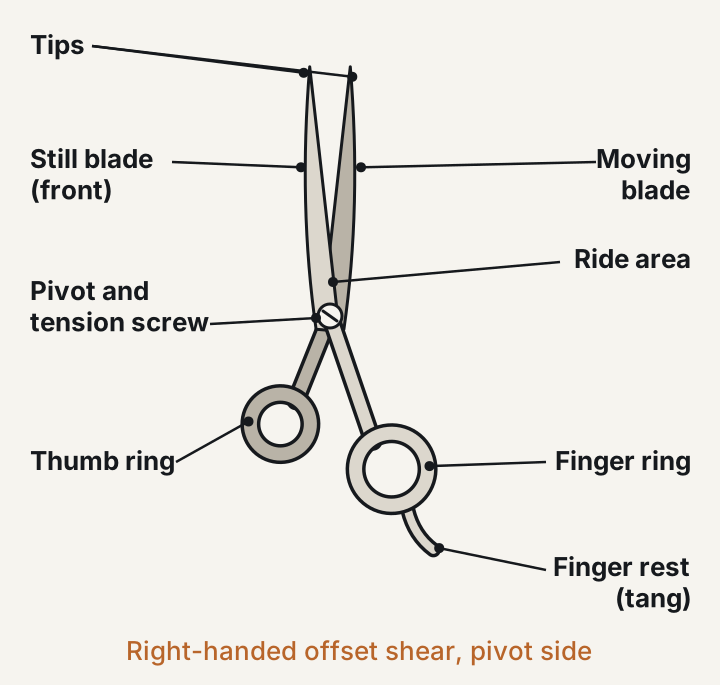
The pivot is the joint the two blades turn on, usually a screw with washers or a bearing. Tension is how firmly the pivot holds the blades together as they close. Too loose lets hair fold between the blades; too tight makes the action drag.
Tension is not sharpness. The drop test checks it, and the pivot systems guide explains how the main adjusters work.
2. Whole-shear length
The size on a barber scissor is normally the whole-shear length, measured from the tip to the end of the finger ring. It is not the length of the cutting blade, which is shorter. Two shears with the same label can differ in blade length because handles differ.
Yasaka, for example, lists its 5.5″ Offset at 145 mm overall with a 54 mm blade on its SM-550 spec page. The size guide shows each length to scale.
3. Offset handle
On an offset handle the thumb shank is shorter, so the thumb ring sits lower than the finger ring. A classic handle keeps the rings level. A crane handle is an offset angled away from the line of the blade, and a swivel has a thumb ring that turns.
These describe geometry, not a promise about comfort. The handle guide shows each type.
4. Convex edge
A convex edge has an outer face that curves all the way to the cutting edge, which makes a very fine edge. It slices cleanly and suits point and slide cutting. Convex describes the edge shape, not the steel, and not where the shear was made.
Because the curve is the edge, sharpening has to preserve it. The convex vs bevel guide explains why.
5. Bevel edge and micro-serration
A bevel edge has a flat face that ends in a short angled facet. Micro-serration is a row of fine teeth on one blade’s edge that grips the hair and holds it still. That helps in blunt cutting and over the comb, and it works against slide cutting.
Do not confuse micro-serration with the large teeth of a thinner. The scissor blades post compares the edges.
6. Sword blade
A sword blade has a reinforced body, usually with a raised ridge along the outer face. It describes the shape of the blade, not the finish of its cutting edge or the steel. A sword blade can have a convex edge or a bevel edge.
The sword blade list compares models. Joewell’s blade guide shows how one maker names blade types.
7. HRC
HRC is Rockwell hardness on the C scale, a measure of how hard the steel is. Listings show it as a figure or a range. It is one property among several, so it does not score sharpness, comfort or lifespan.
Read it beside the steel name. The steel guide and the VG10, 440C and ATS314 comparison explain what the numbers can and cannot tell you.
8. Tooth count
Tooth count is the number of teeth on a thinning, blending or texturising blade. As a rule of thumb, fewer, wider teeth take more per closure and more, finer teeth soften more gently. Spacing and tooth shape matter as well, so the count is a starting point.
A 30-tooth blender and a 10 to 16 tooth chunker do different jobs. The texturising guide explains them.
9. Scissor-over-comb
Scissor-over-comb is cutting the hair a comb has lifted and set, taking only what stands above the teeth. It is the main scissor technique in a fade and a reason barbers buy 6.5″ and 7.0″ cutters.
The scissor-over-comb tips go through the habits, and the long scissors list compares the shears.
10. Blunt cutting
Blunt cutting is a technique: closing the blades across a section to make a defined line. It has nothing to do with a dull blade. A blunt cut is made with a sharp pair.
Dull scissors are a separate problem with a separate test. The blunt scissors guide covers it, so you can tell the two meanings apart.
What would change this list
If you are buying a first pair, terms 2, 3 and 4 do most of the work. If you are comparing premium models, terms 5, 6 and 7 start to matter. If you are adding a thinner, term 8 is the one to learn. The types of scissors post sorts the tools by job.
Pick by career stage
- Apprentice: terms 2, 3 and 10. Length, handle and the technique word your trainer uses.
- Working barber: terms 4, 5 and 9. Edge shape and the way you cut.
- Upgrade: terms 6, 7 and 8. Blade body, hardness and tooth count.
Start from the complete buying guide when you are ready to choose.
Further reading: for wider scissor background, see Scissorpedia. Scissorpedia is a fellow member of the ShearAlliance (see ShearAlliance).
For longer explanations of each term, use the knowledge base.
Questions
What does a convex edge mean on barber scissors?
The outer face of the blade curves all the way to the cutting edge, giving a fine edge that slices cleanly. It is an edge shape, not a steel grade or a country of origin. A bevel edge, by contrast, ends in a short angled facet.
What does HRC mean on a scissor listing?
HRC is Rockwell hardness on the C scale, a measure of how hard the steel is. It is one property among several. It does not score sharpness, comfort or how long the pair will last.
Is blunt cutting the same as cutting with blunt scissors?
No. Blunt cutting is a technique: closing the blades across a section to make a defined line. Blunt scissors are dull ones that need a sharpener. The same word describes two unrelated things.
Is the size on a scissor the blade length?
Usually the whole-shear length, from tip to the end of the finger ring, so a 6.0″ shear has a shorter cutting blade. Check whether a maker lists overall or blade length before you compare models.