Parts of Barber Scissors: A Labelled Diagram
Every part from tip to finger rest, what it does, and what to check on each one.
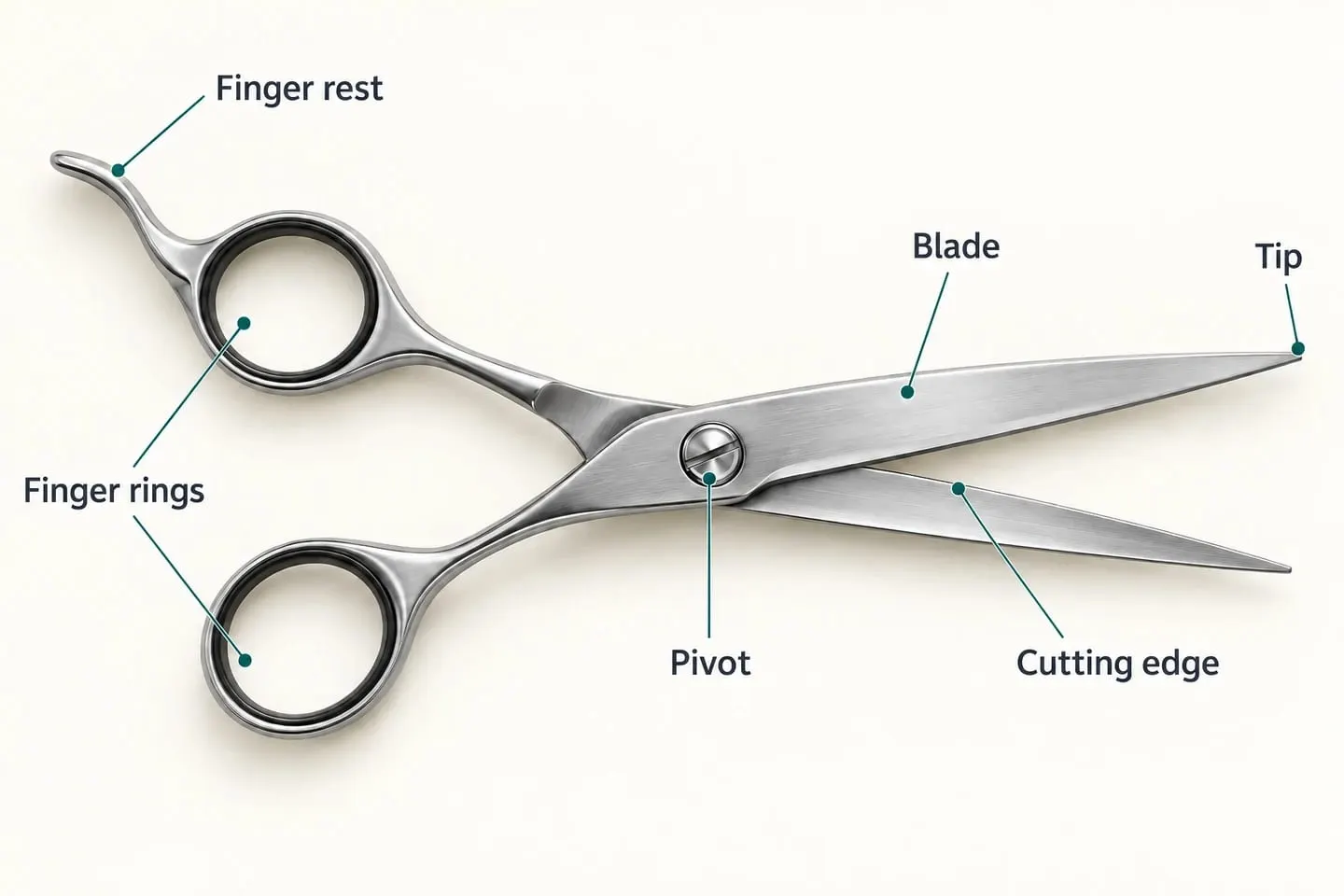 Illustration
 Quick answer
Barber scissors have two blades joined at a pivot screw. The still blade carries the finger ring and finger rest; the moving blade carries the thumb ring. Each blade has a tip, a cutting edge, a hollow-ground inner face and a ride line near the spine. Shanks join the pivot to the rings.
A barber scissor has two blades, a pivot that joins them, and a handle with two rings. Knowing the name of each part makes it easier to describe a fault, follow a care instruction or book a service. The diagram below labels the parts on a right-handed offset shear, tips up.
The parts of a barber scissor
Scroll sideways to compare all columns.
| Part | Where it is | What it does |
|---|---|---|
| Tips (points) | Far end of both blades | Point cutting and detail; the first thing to check after a drop |
| Still blade | The blade on the finger-ring side | Stays steady while you cut; rests on the comb in over-comb work |
| Moving blade | The blade on the thumb-ring side | Closes onto the still blade when the thumb moves |
| Cutting edge | Along the inner side of each blade | Does the cutting; convex or bevel |
| Spine | The outer back of each blade | Gives the blade its stiffness |
| Inner face (hollow grind) | The inside of each blade | A slight concave curve that cuts friction between blades |
| Ride line (ride area) | Strip on the inner face near the spine | Where the blades touch as they close |
| Heel | Blade end nearest the pivot | Gives the most cutting force on thick sections |
| Pivot and tension screw | Where the blades cross | Holds the blades together and sets tension |
| Shanks | Between the pivot and each ring | Set the handle layout: classic, offset or crane |
| Thumb ring | End of the moving blade’s shank | Takes the tip of the thumb |
| Finger ring | End of the still blade’s shank | Takes the ring finger |
| Ring inserts | Inside the rings | Reduce the ring opening |
| Finger rest (tang) | Hook on the finger shank | Little finger sits here to steady the still blade |
| Stopper (bumper, silencer) | Between the shanks near the rings | Stops the blades over-closing and quietens the close |
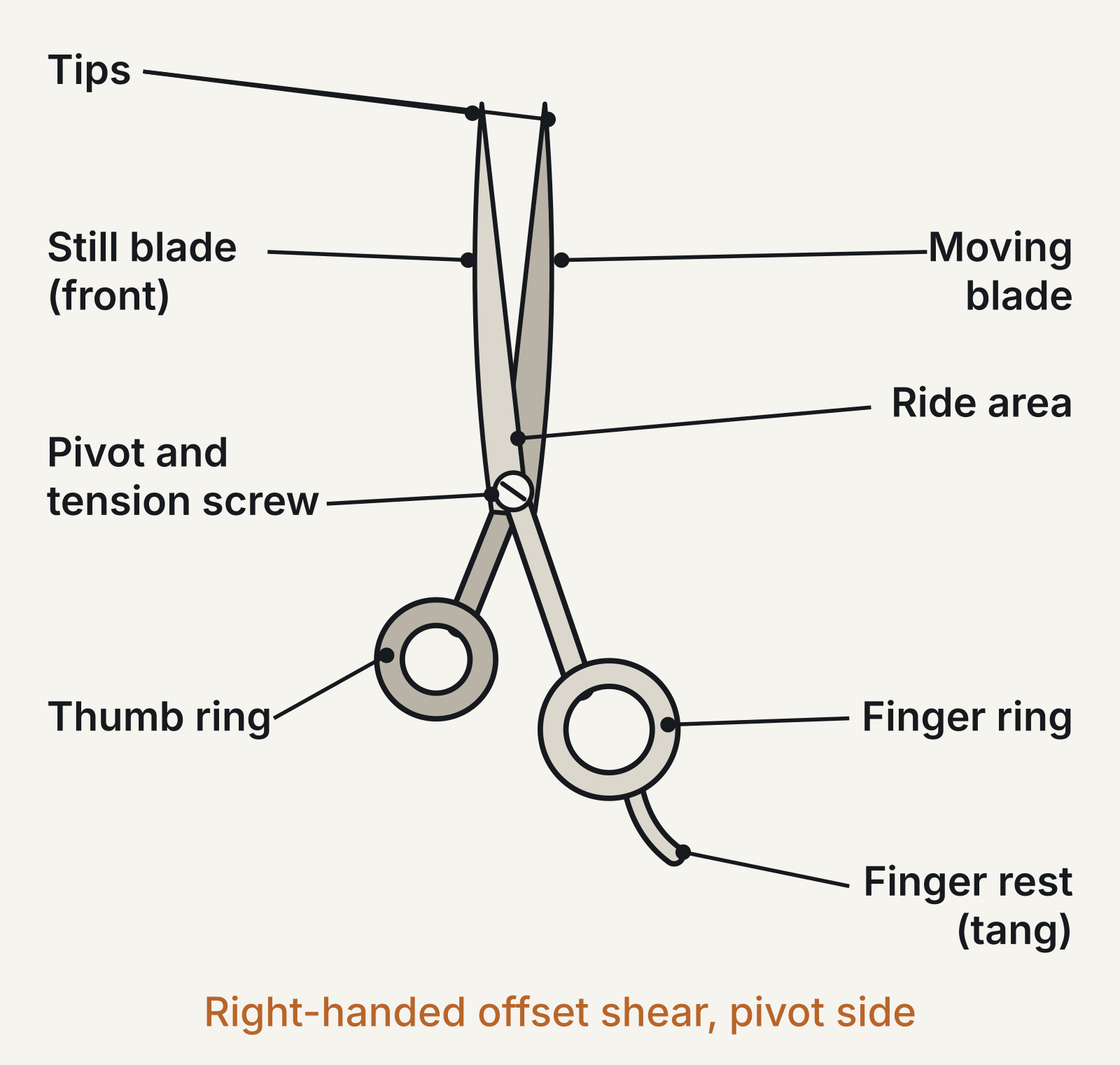
The cutting end: tips, edge and blade faces
The tips are the last few millimetres of each blade. They do the detail work, and a bent or chipped tip is the most common damage after a drop.
The cutting edge runs along the inner side of each blade. On a convex edge the outer face curves all the way to the edge; on a bevel edge a flat face ends in a short angled facet, sometimes with fine serrations. The convex vs bevel edge guide shows both in cross-section.
The spine is the back of the blade. A sword blade keeps the spine and edge straight for longer, which is why it sits flat along a comb. The types of barber scissors shows the main blade shapes.
Inside the blades: hollow grind and ride line
Turn an open shear over and look at the inner face of a blade. Most professional shears are hollow ground: the inner face is slightly concave. Because of that curve, the blades only touch in two places, along the cutting edge and along the ride line near the spine.
That is why the inner face matters to a sharpener. A grind that flattens the hollow or the ride line changes how the blades meet. It is also why you should never sharpen a professional shear on a flat stone yourself. The sharpening services guide lists what to ask a sharpener.
The pivot and tension screw
The pivot is where the blades cross and turn. The tension screw holds them together and sets how firmly they meet. Too loose and the blades part and fold hair; too tight and the action drags.
Pivot systems differ by maker. Some use a flat screw, some a dial or click adjuster, some a bearing. Joewell’s handle and screw specifications show its screw types. The pivot systems guide compares them, and the maintenance guide shows the drop test for tension.
The handle: shanks, rings, rest and stopper
The shanks run from the pivot to the rings. Their lengths set the handle type: equal on a classic handle, shorter on the thumb side for an offset. The handle types guide explains each layout.
The thumb ring belongs to the moving blade and the finger ring to the still blade. Ring inserts sit inside the rings to reduce the opening. The finger rest, also called the tang, is where the little finger goes; on some models it unscrews. The stopper is a small rubber or plastic bumper between the shanks that stops the blades closing past each other.
On a left-handed shear every one of these parts is mirrored. The left-handed scissors guide shows the difference.
Use the names when something goes wrong
Naming the part turns “my scissors feel wrong” into a question someone can answer.
- Hair folding at the tips: check tips for a bend, then check tension.
- Rough or gritty close: clean the pivot and ride line; look for a nick on the edge.
- Clicking on close: check the stopper is in place and the blades are not over-closing.
- Shear moving in the hand: fit ring inserts.
- Edge snagging in one spot: look for a nick and book a sharpener.
The blunt barber scissors tests take each symptom further. For the rest of the buying decision, read how to choose barber scissors, or browse cutting shears by handle and length.
Questions
Which blade moves on barber scissors?
The blade attached to the thumb ring moves. The blade attached to the finger ring and finger rest stays still. In the standard hold only the thumb moves, so the still blade stays steady against the comb or your fingers.
What is the ride line on scissors?
The ride line is the narrow strip along the inner face of each blade, near the spine, where the two blades touch as they close. Together with the edge, it is where the blades meet. Wear or damage there makes the action rough.
What is the tang on barber scissors?
The tang is the finger rest: the hook on the finger shank where the little finger sits. It steadies the still blade. On some models it screws off so you can remove it.
What does the screw on barber scissors do?
The pivot screw holds the blades together and sets the tension. Tighter pulls the blades closer; looser lets them part. Some screws have a dial or click system, others a flat slot. Follow the maker's method for your model.
What is a hollow grind?
A hollow grind is a slight concave curve on the inner face of each blade. It means the blades touch only at the edge and the ride line, so they close with less friction. Most Japanese-style barber shears have one.