Barber Scissor Glossary: Terms Explained
The terms on a barber scissor listing in plain words, from ATS-314 to weight line.
 Illustration
Quick answer
This glossary defines the terms on a barber scissor listing, from ATS-314 and hollow grind to tang, tension and weight line. Each entry opens with a one-sentence definition, then says what it changes when you choose or look after a pair. Terms run alphabetically, and every term has its own link.
A glossary is only useful if you can find a term in seconds, so every term below has its own heading and link, in alphabetical order. Each opens with a one-sentence definition. The sentences after it say what the term changes when you choose, hold or look after a pair. Reviewed 4 November 2026.
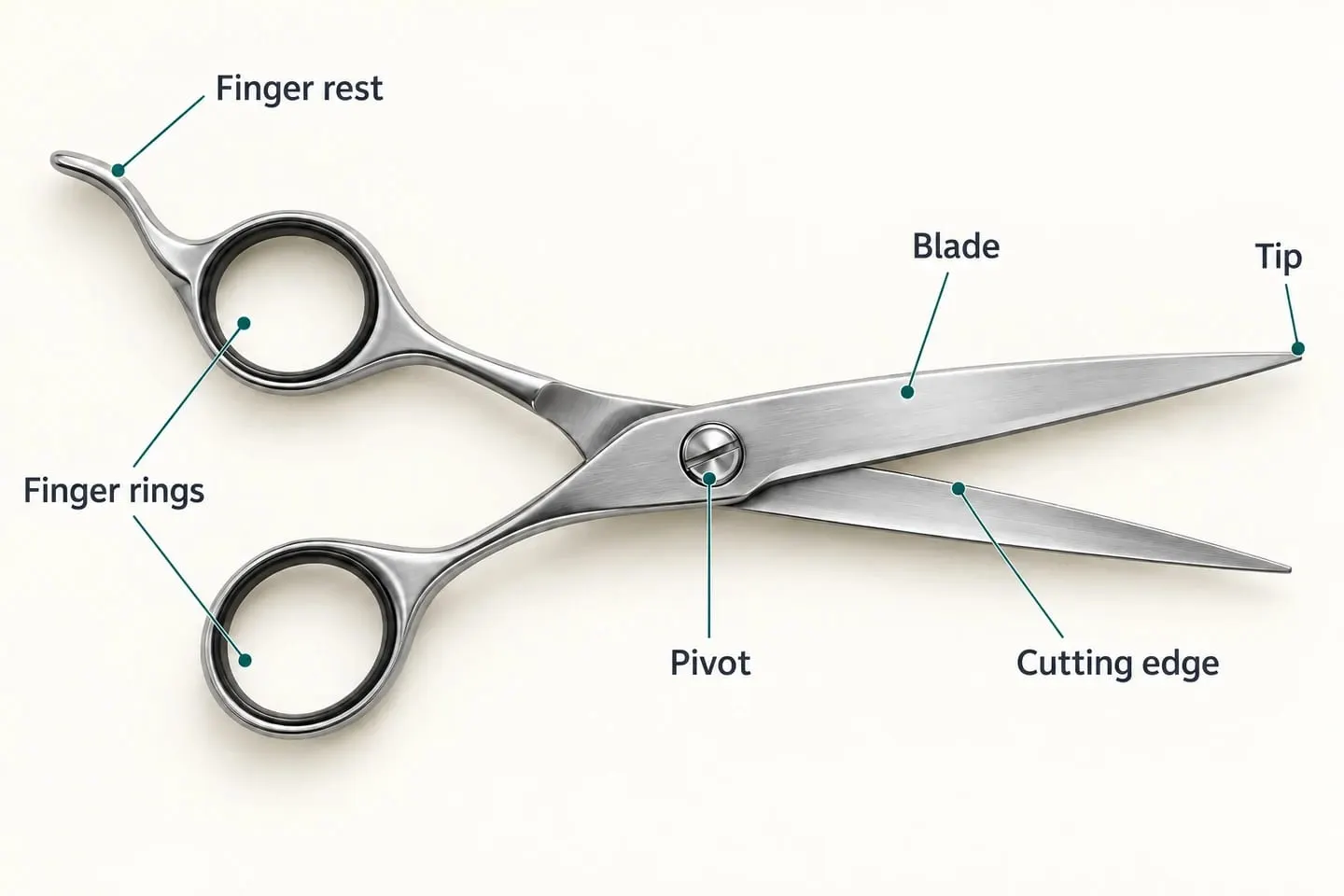
Looking for the bigger picture? The knowledge base collects every guide, the parts of barber scissors labels the diagram, and the barber scissor FAQ answers the questions people ask most. For general scissor background beyond what we sell, Scissorpedia is a ShearAlliance information website.
Names overlap between makers, so where a term has more than one name the entry says so. Where a measurement matters, the entry says which one.
Terms that start with a number
30-tooth blender
A 30-tooth blender is a thinning shear with 30 fine teeth, the common all-rounder for softening fades and light weight removal. It takes a little hair from the whole section and leaves length alone. Buy the cutter first and add this when blending is part of every shift. See thinning vs texturising shears.
440C
440C is a high-carbon stainless steel and the working standard for barber scissors. It takes a good edge, resists corrosion and sharpens without fuss, which is why it suits apprentices and backup pairs. The steel guide compares it with VG-10 and ATS-314.
Terms beginning with A
Adjuster
The adjuster is the part you turn to set the tension: a slotted screw, a coin-slot screw or a tool-free dial, depending on the maker. Turn it a quarter turn at a time and test again. The pivot systems guide shows each type.
Ambidextrous
Ambidextrous describes a handle that is symmetrical, usually on right-handed blades. It is a handle word, not a blade word, so the blades still close the right-handed way and fold hair in a left hand. Ask whether the blades are reversed before you buy. See the left-handed guide.
ATS-314
ATS-314 is a cobalt stainless steel used on premium Japanese shears, listed at 62 to 63 HRC across our range. It takes a very fine edge and needs a sharpener with the right equipment. Compare it with the others in VG-10 vs 440C vs ATS-314.
Terms beginning with B
Backup pair
A backup pair is a second cutter in the same hand and length as your main shear, kept sharp for the days the main pair is away being serviced. It also takes the rough or dry work that wears a main pair. Every barber who posts scissors to a sharpener needs one. See sharpening services in Australia.
Bevel edge
A bevel edge has a flat outer face that ends in a short angled facet, so it grips hair rather than slicing it. It holds the line well on dry hair and suits learning and blunt cuts. It is easier to sharpen than a convex edge. See convex vs bevel edge shears.
Blade
The blade is the working part of each half of the scissor, running from the pivot to the tip. Do not confuse it with overall length: on a 7.0″ shear the blade is a little under half. Blade shape and edge are separate choices. The parts guide labels each section.
Blade fit
Blade fit, also called the set, is how the two blades are positioned against each other so they meet progressively along the edge as they close. It is part of why hand-finished shears cost more. A knock or a drop can disturb it, which is why a dropped pair needs assessing before it goes back on a client. See why barber scissors are expensive.
Blender
A blender is the barber’s word for a thinning shear used to soften transitions, usually with around 30 fine teeth. It blends the top into the sides and takes light weight out without leaving visible holes. For heavy texture use a chunker instead. See best thinning shears for barbers.
Blunt cut
A blunt cut is a cut where the blades close straight across a section to form a defined line. The word describes the technique, not a dull scissor. Bevel and micro-serrated edges hold the section still for it. See scissor blades explained.
Bumper
A bumper is the small rubber or plastic stop between the shanks that cushions the handles and stops the blades closing past each other. It is also called the stopper or silencer. A missing bumper is a service job, not a sharpening job. See troubleshooting clicking.
Terms beginning with C
Chunker
A chunker is a toothed shear with 10 to 16 wide teeth, built to remove a visible chunk of hair with each closure. It is the quickest way to take bulk out of thick or curly hair and too strong for blending a fade. See scissors by hair texture.
Classic handle
A classic handle has two shanks of equal length, so the thumb ring and finger ring sit level and opposite each other. It is the traditional barber layout and suits scissor-over-comb with the thumb low. Browse the classic handle range or read the handle types guide.
Clipper-over-comb
Clipper-over-comb is a technique where the comb lifts hair and a clipper trims what stands above it. It is faster than scissors on short sections. Scissors take over where you need finer control through a transition. See fade cutting shears.
Cobalt
Cobalt is an element added to some steels, and on its own it is not a steel name. ATS-314 and VG-10 are stainless steels that contain cobalt, and some makers also use a cobalt-base alloy, which is a different material. Read the full steel name on the product page. See the steel guide.
Coin-adjust screw
A coin-adjust screw is a pivot screw with a wide slot that you turn with a coin, so you can reset tension between clients without carrying a tool. Jaguar’s Vario screw works this way. The pivot systems guide compares it with the other types.
Convex edge
A convex edge curves smoothly from the spine to a very fine edge with no flat facet, so it slices rather than chops. It suits slide cutting, point cutting and wet hair, and it needs a sharpener who can rebuild the curve. It is also called a clam-shaped or hamaguri edge. See convex vs bevel edge shears.
Crane handle
A crane handle is an offset handle with the thumb shank angled down, away from the line of the blade. With the blade held level, the elbow sits lower than it would with a classic or offset handle. It is a deliberate choice for barbers who can name what it should change. See handle types.
Cutter
A cutter is a barber’s word for a straight-bladed shear that makes the cut, as opposed to a thinner that only removes weight. Most kits start with one cutter, usually a 6.0″ offset. See types of barber scissors for the main cutter lengths and what each does.
Cutting comb
A cutting comb is the comb used for scissor-over-comb work, where it lifts the hair and sets the line for the scissor. Its tooth spacing and length should suit the blade you use. See the cutting comb picks.
Cutting ratio
A cutting ratio is the approximate share of hair a maker says a thinning shear removes in one closure, under its test conditions. It is not the share of a whole haircut. Where a maker publishes one, use it alongside tooth count. See thinning vs texturising shears.
Terms beginning with D
Double-edge blade
A double-edge blade is a blade with a cutting edge on both long sides, used in a double-edge safety razor such as the Feather AS-D2. Each handle takes its own blade family, so match the refill to the razor. See the Feather brand page.
Drop test
The drop test is the quick check for tension: hold the shear by the finger ring with the tips up, lift the thumb blade to about 90 degrees and let go. It should stop about two thirds closed. If it snaps shut the tension is loose, and if it barely moves it is tight. Follow the maker’s method where it differs. See the maintenance guide.
Terms beginning with E
Edge
The edge is the sharpened line along the inner side of each blade that does the cutting. Edges are described as convex, bevel or micro-serrated, and the edge decides how the shear meets the hair. See barber scissor blades.
Terms beginning with F
Fade
A fade is a haircut where hair graduates from very short at the bottom to longer above it. The clipper cuts the short sides and the scissor does the transition, the top and the detail. See barber scissors for fades.
Feather Artist Club
Feather Artist Club is a range of Feather folding razors that take replaceable Professional blades, used for outlines, line-ups and neck shaves. The handles take the PS-20, PB-20, PL-20 or PG-15 blades. See the Feather brand page.
Finger rest
The finger rest is the hook on the finger shank where the little finger sits, and it steadies the still blade. It is also called the tang. On some models it screws off, and a removable rest is normally left out of the size measurement. See how to hold barber scissors.
Finger ring
The finger ring is the ring on the still blade’s shank, where the ring finger sits. It does not move when you cut. Ring inserts can reduce its opening if the shear feels loose. See the parts guide.
Finish
A finish is the colour or coating on the steel, such as black, rainbow, gold or rose gold. It changes the look and needs gentle care, but not the cutting spec. Settle length, hand, edge and steel first. See barber scissor finishes.
Flat screw
A flat screw is a slotted pivot screw that sits close to the blade and is turned with a screwdriver or key. It keeps a low profile and suits barbers who set the tension once and leave it. See the pivot systems guide.
Flat top
A flat top is a haircut with the top cut level, usually over a comb on a short base. It rewards a long blade because the line has to stay even across a wide section. See long barber scissors for scissor-over-comb.
Folding razor
A folding razor is a razor with a blade that folds into the handle, used by barbers for outlines, line-ups and neck shaves. The blade is replaceable, so you buy the handle once and the blades often. See barber razors.
Terms beginning with H
Handedness
Handedness is whether a scissor is built for the right or the left hand. It is a property of the blades, not just the rings: a true left-handed shear has reversed blades. Check it before length, handle or steel. See the left-handed guide.
Heel
The heel is the part of each blade nearest the pivot. It gives the most cutting force, which is why it is used on thick sections. A problem confined to the heel is different from one at the tips. See the parts guide.
Hollow grind
A hollow grind is a slight concave curve on the inner face of each blade, so the blades touch only along the cutting edge and the ride line. It cuts friction as the blades close. A sharpener should hone the inner face, not grind it flat. See parts of barber scissors.
HRC
HRC is hardness on the Rockwell C scale, measured by pressing a diamond point into the steel under a set load. Barber scissors usually sit between 56 and 63 HRC. Higher is harder, but it is one property, not a score for the whole scissor. See what HRC means.
Terms beginning with I
Inner face
The inner face is the inside surface of each blade, the side that faces the other blade. On most professional shears it is hollow ground. It is what a sharpener must preserve, because it decides where the blades touch. See the sharpening guide.
Terms beginning with L
Left-handed scissors
Left-handed scissors are shears built as a mirror image of right-handed ones, with reversed blades as well as a mirrored handle. They keep the cutting line visible and close properly under a left-handed thumb. The left-handed range lists what is available.
Length
Length is the overall size of the shear in inches, from the tip of the blades to the end of the finger ring. It is not the blade length. Common barber lengths run from 5.0″ to 7.0″. See the size guide and the size chart.
Terms beginning with M
Mail-in sharpening
Mail-in sharpening is a service where you post your scissors to a sharpener and they post them back. It suits barbers far from a workshop and needs a booking, careful packing and a backup pair. See how to post scissors for sharpening.
Micro-serration
Micro-serration is a set of fine grooves along the edge of one blade that stops hair sliding. It grips firmly, which helps on dry and fine hair and while learning, but it will not slide cut. Regrinding the serrations needs a service set up for them. See convex vs bevel edge shears.
Mobile sharpening
Mobile sharpening is a service where the sharpener visits your shop and services the scissors on site. It suits shops with several stations because nobody loses a tool for days, but visits run on a schedule, so book ahead. See sharpening services in Australia.
Moving blade
The moving blade is the blade attached to the thumb ring, and it closes onto the still blade when the thumb moves. In the standard hold only the thumb moves. See the parts guide.
Terms beginning with N
Nape razor
A nape razor is a narrow guarded razor, such as Feather’s Nape type, for clean neck edges. It takes its own Nape blades. See Feather razors and blades.
Terms beginning with O
Offset handle
An offset handle has a thumb shank shorter than the finger shank, so the thumb ring sits closer to the pivot and slightly forward of the finger ring. It is the default for most barbers and apprentices. See offset handles and the handle types guide.
Terms beginning with P
Pivot
The pivot is the screw joint where the two blades cross and turn, and it sets the tension. Five types cover almost every barber shear: flat screw, coin-adjust, tool-free dial, ball-bearing and dry-bearing. See the pivot systems guide.
Point cutting
Point cutting is a technique that uses the tips of the blades to cut into the ends of a section, breaking up a hard line or adding texture. It suits a sharp convex tip. See short barber scissors for detail.
Pre-order
Pre-order means a product is taken ahead of stock arriving. The product page labels it, and checkout shows handling and arrival estimates before you pay. Contact us first if you need it by a set date. See orders, shipping and returns.
Profile
Profile is the outline of the blade seen from above, such as a sword blade for scissor-over-comb. It is separate from the edge, so a listing tells you two things: the profile and the edge. See barber scissor blades.
Terms beginning with R
Razor cutting
Razor cutting is cutting or texturising hair with a guarded razor instead of scissors. Barbers use it for texture and tapered ends, and keep scissors for length and the line. See Feather razors.
Ride line
The ride line is the narrow strip along the inner face of each blade, near the spine, where the two blades touch as they close. Wear or damage there makes the action rough, and over-tightening the pivot wears it. See parts of barber scissors.
Ring inserts
Ring inserts are rubber or silicone rings that fit inside the thumb or finger ring to reduce the opening. They do not move the ring along the shank. Try them before changing models if the rings feel loose. See handle types.
Terms beginning with S
Safety razor
A safety razor is a razor with a fixed head that holds a blade at a set angle, used for full wet shaves. Feather’s AS-D2 is a stainless double-edge safety razor. See the Feather brand page.
Scissor-over-comb
Scissor-over-comb is a technique where the comb lifts the hair and the scissor cuts what sits above the comb, so the comb sets the line. Blade length decides how much comb you cover per pass, which is why barbers use 6.5″ to 7.0″ shears. See scissor-over-comb scissors.
Servicing
Servicing is the work a sharpener does on a pair, which can include inspection, sharpening, tip alignment, a pivot clean and tension reset. Sharpening is only one part of it. See the sharpening guide.
Set
A set is a cutter and thinner sold together, often with matching handles, and often the cheapest way to get both tools. Check the hand and length of each tool. In blade terms, set also means blade fit. See barber scissor sets compared.
Shank
The shank is the arm that runs from the pivot to each ring. Shank lengths set the handle type: equal on a classic handle, shorter on the thumb side for an offset. See the parts guide.
Sharps container
A sharps container is a puncture-resistant container for used razor blades, kept at the station. Change the blade between clients and drop used blades in it. Follow your state and workplace rules for disposal. See razors and blades.
Slide cutting
Slide cutting is a technique where the blades move along the hair so the section is sliced rather than closed on. It needs a convex edge, because a bevel edge catches. See the convex vs bevel guide.
Spine
The spine is the outer back of each blade, opposite the cutting edge. It gives the blade its stiffness. On a sword blade the spine and edge stay straight for longer. See the parts guide.
Still blade
The still blade is the blade attached to the finger ring and finger rest, which stays steady while you cut. In scissor-over-comb it is the one that rests against the comb. See the parts guide.
Styling razor
A styling razor is a guarded razor for razor cutting and texturising, such as Feather’s Standard type. It is added for texture work beside shears, not instead of them. See Feather razors and blades.
Swivel thumb
A swivel thumb puts the thumb ring on its own small pivot, so the ring rotates as you change cutting angle. It suits barbers who rotate the shear a lot, takes time to learn and adds a joint to clean and oil. See the handle types guide.
Sword blade
A sword blade is a blade shape with a long, straight spine and edge and a slight curve near the tip. It keeps more of the edge in contact with the comb, which suits scissor-over-comb and long slicing. It describes shape, not edge. See sword blade barber shears.
Terms beginning with T
Tang
The tang is another name for the finger rest: the hook on the finger shank where the little finger sits. It steadies the still blade. See how to hold barber scissors.
Taper
A taper is a haircut where the length graduates gradually from shorter at the neckline and sides to longer above. Long tapers reward a long blade for scissor-over-comb. See fade cutting shears.
Tension
Tension is how firmly the pivot holds the blades together. Too loose and the blades part and fold hair; too tight and the action drags. Tension cannot sharpen a dull edge. Check it weekly with the drop test. See the maintenance guide.
Texturiser
A texturiser is a toothed shear with 14 to 20 wider-gapped teeth that takes visible pieces of hair. It breaks up solid lines and adds movement on top. Names overlap between makers, so read the tooth count. See thinning vs texturising shears.
Thinner
A thinner, or thinning shear, is a shear with one straight blade and one toothed blade, used to remove weight and soften lines without changing length. Tooth count and tooth shape decide how much hair each closure takes. See thinning shears.
Thumb ring
The thumb ring is the ring on the moving blade’s shank, where the tip of the thumb sits. It is the only part that moves in the standard hold. On a swivel handle it rotates. See how to hold barber scissors.
Tip
The tip is the last few millimetres of each blade, which does the detail work and the point cutting. A bent or chipped tip is the most common damage after a drop. See the blunt shears guide.
Tool-free dial
A tool-free dial is a pivot adjuster you turn by hand, so you can check and set tension without a tool. Set it before work and leave it. See the pivot systems guide.
Tooth count
Tooth count is the number of teeth on the toothed blade of a thinner. On the same blade length, more teeth means narrower gaps. Count alone does not tell you how much hair is removed, because tooth shape matters too. See thinning shears.
Tooth shape
Tooth shape is the profile of each tooth and gap on a thinner, such as V-shaped or U-shaped. It affects how hair is held and how much is removed. Read it alongside tooth count. See thinning vs texturising shears.
True left-handed
True left-handed describes a scissor whose blades are reversed for the left hand, not just a right-handed pair with a mirrored handle. A true lefty is a separate model or option on the product page. See the left-handed guide.
Terms beginning with V
VG-10
VG-10 is a stainless steel with cobalt and vanadium added, usually finished at 60 to 62 HRC in scissors, harder than most 440C. It sits in the mid to upper range. See VG-10 vs 440C vs ATS-314.
Terms beginning with W
Weight line
A weight line is the visible edge where the heavier, longer hair sits over shorter hair, such as where the top meets a fade. A 30-tooth blender or point cutting softens a hard one. See fade cutting shears.
Where to go next
Pick a term, then act on it. To choose a pair, work through how to choose barber scissors. To keep one working, use the care and servicing hub. For a first kit by budget, read the first professional kit guide.
Scissorpedia is a fellow member of the ShearAlliance; see ShearAlliance.