Equipping a Barber Team: Matched Sets, Spares and Rotation
How a shop owner keeps every chair working: one handle standard, a spare per hand, and a service rotation that never empties a station.
 Illustration
Quick answer
Equip a barber team with a handle standard, a matched cutter and thinner per chair, one spare cutter for each hand in use, and a service rotation that sends one pair away at a time. Assign each barber's working pair, keep spares shared, and log every tool so nothing goes missing.
Top picks
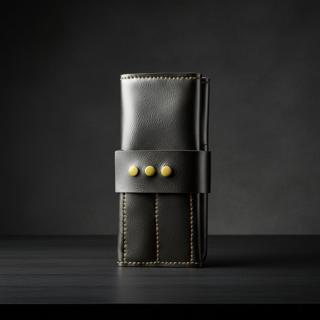
Station storage
Juntetsu Sentinel Fold Wallet - 8 Pocket Professional
Eight pockets with protective flaps
A shop’s scissor kit is an operating system, not a shopping list. Standardise the handle, give each barber an assigned pair, hold a spare for every hand in use, and rotate service so a chair is never left without a working pair. The procurement guide covers briefing and ordering; this guide covers running the kit day to day.
Key takeaways
- One handle standard and a matched cutter and thinner per chair.
- Assigned working pairs, shared spares.
- Stagger service. Log every tool in and out.
Why a shop needs a policy
Scissors are the tools most affected by use patterns. Tension, wear and feel settle to the hand that uses them. A shop without a policy ends up with borrowed pairs that feel wrong, tools that go for service together and leave a gap, and nobody sure which pair is whose.
The policy has four parts: a standard, assigned pairs, spares and a rotation.
Matched sets and handle standards
Pick one handle style for the shop’s standard pairs where you can. When the cutter and thinner share a handle, a barber does not have to adapt between tools, and a new hire learns on a consistent kit. Sets pair a cutter and a thinner already, and the set comparison shows models.
Individual barbers may prefer different handles, and the handle guide explains the options. A standard is a default, not a rule against fit. A left-handed barber needs a true left-handed pair; see the left-handed working guide.
Assigned and shared pairs
Scroll sideways to compare all columns.
| Type | Who uses it | Why |
|---|---|---|
| Working pair | One barber | Tension and wear match that hand |
| Spare cutter | Anyone, in the right hand | Finishes a cut when a pair is away |
| Spare thinner | Anyone, in the right hand | Keeps blending going |
| Training pair | Apprentices | Keeps new hands off the good pair |
Label every pair with a name or station number. Unlabelled tools cause more disputes than damaged ones.
Spares: one per hand in use
Keep a spare cutter for each hand in use. A shop with right-handed and left-handed barbers needs a spare of each. Pick a length that can finish any cut, since a spare that cannot do detail is not a spare. The length guide helps choose.
The spare should be sharp and set up. A dull spare fails at the moment it is needed.
Rotation: send one pair away at a time
Sharpening takes a pair out of use. If all staff send pairs at once, the shop loses capacity. Stagger them: one pair away at a time, with a spare covering that chair.
- Set a service date per pair from the signs of wear, not a calendar alone. See how often to sharpen convex shears.
- Offset the dates across the team.
- Book the next service before the current pair goes.
- Check the pair on return. The sharpener handover guide has the return check.
A simple tool log
A log can be a page or a sheet. Record for each pair: model, length, hand, owner, purchase date, last service and where it is now.
Scroll sideways to compare all columns.
| Field | Example |
|---|---|
| Tool | 6.0″ offset cutter |
| Hand | Right |
| Owner | Station 2 |
| Last service | Date and provider |
| Location | In use, spare drawer, at service |
The log shows what is due and what is missing, and it supports a warranty claim if a pair fails. See the warranty page.
Station storage and care
Give each station a closed storage place with a slot per tool. A wallet or case at the station beats loose tools on the bench; see the cases guide. Put the care routine on a card at the station and base it on the cleaning guide. Infection-control rules for your premises still apply, and general workplace guidance is at Safe Work Australia.
A worked example: a four-chair shop
Four barbers, one of them left-handed. The owner sets a handle standard of one offset style for the three right-handed barbers and a true left-handed pair in a matching style for the fourth.
Each barber gets an assigned cutter and thinner and a label on the case. The shop keeps one spare cutter in the right hand and one in the left, plus a shared texturiser on the station shelf. Service dates are offset by a week, so one pair is away at a time and a spare covers the chair.
The log is a single sheet by the till, with a line per pair and a column for last service and location. At each service, the owner reads the return-check steps in the sharpener handover guide before the pair goes back to its barber.
When a fifth barber starts, the same pattern extends: an assigned pair, a line in the log and a slot in the rotation. The shop does not need new rules, only another row.
Common mistakes
- Sharing working pairs. They settle to one hand.
- Sending every pair away together. Stagger service.
- No spare in the left hand. A left-handed barber left on a mismatched pair loses the chair.
- No log. Missing tools go unnoticed.
- Buying all the same without checking fit. A standard is a default.
Pick by role
- New hire or apprentice: a training pair in the standard handle. See apprentice kit setup.
- Working barber: an assigned cutter and thinner pair.
- Shop owner: spares, the log and the rotation. The barber kit guide lists what each station needs.
The knowledge base indexes every barber guide.
Further reading: Scissorpedia is an information website and a fellow member of the ShearAlliance.
Questions
Should barbers in a shop share scissors?
Each barber should have an assigned working pair, because tension and wear settle to one hand. Keep spares shared and labelled, and use them while a pair is away for service.
How many spare scissors does a shop need?
At least one spare cutter for each hand in use, in a length that can finish any cut. Add a spare thinner if blending is core work. Scale to how long a pair is away for service.
How do I keep chairs working while scissors are sharpened?
Stagger service so only one pair is away at a time, and use a spare for that chair. Book the next service before the pair goes, so the rotation does not drift.
Are matched sets worth it for a shop?
A cutter and thinner in the same handle standardise the feel and make training easier. Sets pair them already, so ordering is simpler. Individual barbers may still prefer their own handle.