10 Questions Apprentice Barbers Ask About Scissors

Quick answer
Apprentices ask the same ten things. Start on a 5.5″ or 6.0″ offset cutter, keep the hand and handle your trainer uses, wait for the course tool list before buying, learn the drop test and the daily wipe, and keep your first pair until you know your length and handle. Steel can wait.
An apprentice’s first scissors raise the same ten questions in the first month. This list answers them in the order they come up, answer first, with the link to go deeper if you need it.
How this list was chosen: these are the questions that decide what you buy and how you look after it, ordered from the first purchase to the first upgrade. Answers follow our own guides and make no claim to replace your trainer’s instruction. Reviewed 4 November 2026. If your trainer says something different, your trainer wins, and the guides are there to help you ask why.
The ten questions at a glance
Scroll sideways to compare all columns.
| # | Question | Short answer |
|---|---|---|
| 1 | What length first? | 5.5″ or 6.0″ |
| 2 | When do I buy? | After the tool list |
| 3 | Offset or classic? | What your trainer uses |
| 4 | Which hand? | A true left for left-handers |
| 5 | How do I hold them? | Only the thumb moves |
| 6 | Do I need a thinner? | When the course asks |
| 7 | How tight should tension be? | Drop test |
| 8 | How often do I clean them? | Wipe daily, oil at close |
| 9 | Does steel matter yet? | Not much |
| 10 | When do I upgrade? | When you know your length and handle |
1. What length of scissors should I start with?
A 5.5″ or 6.0″ cutter. It handles point cutting, clipper-over-comb finishing and detail, and the tip stays where you put it. A 7.0″ is for scissor-over-comb, and it is harder to control while your hands are still learning.
Length is whole-shear length, not blade length. The size guide shows each size to scale, and the apprentice mistakes post covers going long too early.
2. Should I buy scissors before the course starts?
No. Get the tool list first. Training providers set what you need, and some supply part of it on day one. Buying early can leave you with two cutters doing the same job.
Ask your trainer and your employer what you must own, what the shop lends and what you need for the first practical session. The first professional kit guide sets out the order to buy in.
3. Should I choose an offset or a classic handle?
Choose the one your trainer cuts with. On a classic handle both rings sit level. On an offset the thumb ring sits lower than the finger ring. Neither is better; they are different habits, and a trainer can only correct a grip they recognise.
If you have not been told, offset is the most common layout in the barber ranges we stock. The handle guide shows the three types side by side.
4. What if I am left-handed?
Buy a true left-handed pair. The blades are built for the hand that holds them, so a left-hander squeezing a right-handed shear pushes the blades apart and the hair folds. Turning a right-handed shear over does not reverse the blades.
Check the hand on the cutter and the thinner separately. The left-handed guide covers the checks, and the left-handed collection lists what is in stock.
5. How do I hold the scissors?
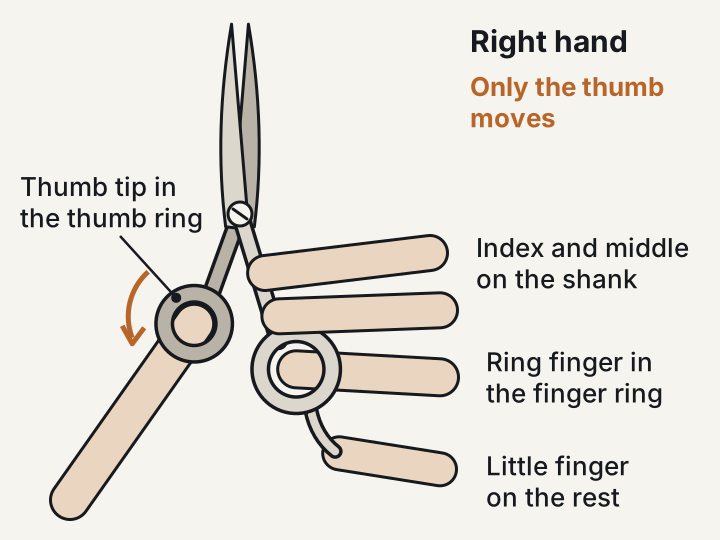
Put the tip of your thumb in the thumb ring and your ring finger in the finger ring. Rest the little finger on the finger rest and lay your index and middle fingers along the shank. Keep the still blade steady and move only the thumb.
The holding scissors guide walks through it in five steps, including the hold for scissor-over-comb.
6. Do I need a thinner?
Only when your course or the work calls for blending. Buy the cutter first. A 30-tooth blender is the usual first thinner, and tooth count is the first thing to check on any model.
The texturising guide explains tooth counts, and a set is worth a look if you need both a cutter and a thinner at once. See scissor sets.
7. How tight should the tension be?
Use the drop test. Hold the shear by the finger ring with the still blade level, lift the moving blade upright and let go. If it falls and stops part way, the tension is about right. If it closes fully it is loose; if it barely moves it is tight.
Adjust in small steps with the maker’s adjuster, and do not take the pivot apart. The pivot systems guide explains the main types.
8. How often do I clean and oil them?
Wipe the blades after every client, and do the full clean and oil at the end of the day. Dry the shear completely, put one drop of oil on the pivot, work it in and wipe off the excess, then close it and case it.
Never put a shear away wet. The cleaning guide has the seven steps.
9. Does the steel matter yet?
Not much. Fit, length, handle and care matter more while you are learning. A well-set, well-kept entry-level pair will carry you through an apprenticeship better than an expensive pair in the wrong length or hand.
When you do compare, read the steel guide for what hardness numbers can and cannot tell you.
10. When should I upgrade?
When you know your length and handle and the pair is holding you back, not before. Until then, keep the first pair sharp and clean. A second cutter in another length is often a better next purchase than a more expensive copy of the first.
The apprentice upgrade guide covers what to look for, and the apprentice scissors list compares first pairs.
What would change this list
If your course supplies a kit, questions 1 to 3 are already answered for you and the list starts at question 7. If you are mobile or self-employed from day one, add a case and a backup pair early; the first kit guide shows where they fit.
Pick by career stage
- First month: questions 2, 5 and 8. Tool list, hold and daily wipe.
- First year: questions 1, 3 and 7. Length, handle and tension settle by now.
- Ready to upgrade: questions 9 and 10. Compare steel and a second length once you know what you need.
Start from the complete buying guide if you want the whole picture in one place. Buying for an apprentice rather than being one? See the gift ideas for barbers.
More apprentice answers are in the knowledge base.
Questions
What scissors should an apprentice barber buy first?
A 5.5″ or 6.0″ cutter in the handle your trainer uses, bought after you have the course tool list. It covers point cutting, clipper-over-comb finishing and detail work. Add a longer shear for scissor-over-comb once your trainer has you on longer sections.
Do apprentice barbers need thinning scissors?
Only when the course or the work calls for blending. A 30-tooth blender is the usual first thinner. Buy the cutter first and add the thinner when your trainer asks for it.
Is a left-handed apprentice stuck with right-handed scissors?
No. A right-handed shear is built for a right hand, so a left-hander needs a true left-handed pair with mirrored blades. Turning a right-handed shear over does not create one.
When should an apprentice upgrade their scissors?
When you know your length and handle and the pair no longer limits you. Until then, keep the first pair sharp and clean. A second cutter in a different length is often a better next buy than a more expensive version of the first.