Are Your Barber Scissors Blunt? 4 Tests and Fixes
Quick answer
Barber scissors are blunt when they push or fold hair after you have cleaned them and set the tension. Run four tests: cut a wet tissue along the blade, close the tips on a single hair, do the tension drop test, and look along the edge under light. If the edge fails after tension is right, book a sharpener.
A blunt barber scissor pushes hair along the blade, folds it at the tips or snags in one spot. Before you blame the edge, clean the pivot and check the tension, because both cause the same symptoms. Then run the four tests below. Each takes under a minute and needs nothing but a tissue, a single hair and a light.
Signs your barber scissors are blunt
- Pushing: hair slides toward the tips instead of cutting where the blades meet.
- Folding: hair bends between the blades at the tips and is left uncut.
- Snagging: the shear catches in the same spot on every cut, which usually means a nick.
- Chewing: the cut end looks frayed instead of clean.
- Effort: you are closing harder than you used to.
If the shear was dropped, look at the tips before anything else. A bent tip causes folding however sharp the rest of the edge is.
Before you test: clean and check
- Wipe the blades and the inner faces near the pivot. Packed hair at the pivot makes a shear feel rough.
- Oil the pivot with one drop, open and close a few times, wipe the excess.
- Check the hand. A right-handed shear in the left hand folds hair because thumb pressure pushes the blades apart. See the left-handed scissors guide.
Now test.
Test 1: the wet tissue test
Wet a single sheet of tissue, hold it by one corner and cut slowly from the heel of the blade near the pivot out to the tips.
- Pass: a clean cut along the whole blade.
- Fail at the tips: the tissue tears or folds in the last few centimetres. The tips are dull or misaligned.
- Fail in one spot: the tissue catches at the same point. That is a nick.
- Fail everywhere: the edge is dull, or tension is loose. Do test 3 before deciding.
A small wet section of hair on a practice head tells you the same thing. Do not test on paper or card, which dulls the edge.
Test 2: the tip test
Hold a single hair, or a few strands, taut. Close only the last centimetre of the blades on it, slowly.
- Pass: the tips cut the hair cleanly.
- Fail: the hair slides out or folds between the tips.
Then close the shear and look at the tips from the side. They should meet evenly. If one sits past the other or a tip is bent, it needs a sharpener, not tension.
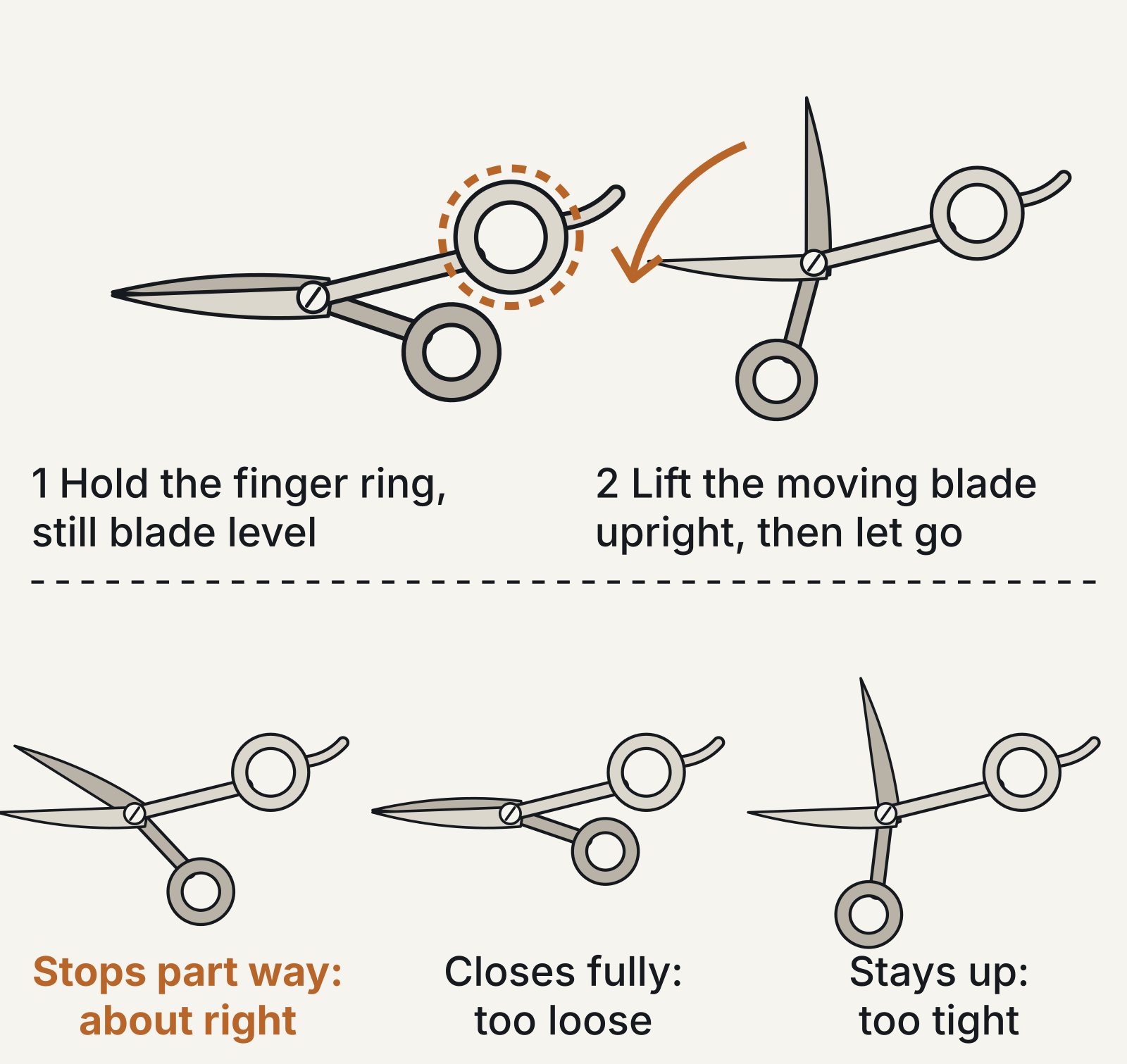
Test 3: the tension drop test
Tension that is too loose lets the blades part and fold hair, which looks exactly like a blunt edge.
- Hold the shear by the finger ring with the still blade level.
- Lift the moving blade upright.
- Let it go.
Right: it falls and stops part way. Too loose: it closes fully. Too tight: it barely moves. Adjust in small steps with the maker’s adjuster, then repeat tests 1 and 2. The maintenance guide covers the routine.
Test 4: the edge light test
Open the shear and hold it under a bright light. Look straight down the cutting edge of each blade.
- Pass: the edge is a fine line you can barely see.
- Fail: a shiny strip along the edge, which is a flattened, dull edge reflecting light, or bright points where there are nicks.
Do not run a finger or thumb along the edge to test it.
What each result means, and the fix
Scroll sideways to compare all columns.
| Result | Likely cause | Fix |
|---|---|---|
| Folds hair, drop test shows loose | Loose tension | Tighten in small steps; retest |
| Folds at tips, tension right | Dull or misaligned tips | Book a sharpener |
| Catches in one spot | Nick in the edge | Book a sharpener |
| Pushes along the whole blade, tension right | Dull edge | Book a sharpener |
| Rough or gritty close | Hair or residue in the pivot | Clean and oil; retest |
| Folds only in the left hand | Right-handed shear | Use a true left-handed pair |
| Bent tip after a drop | Impact damage | Book a sharpener for repair |
When to book a sharpener
If tests 1, 2 or 4 fail with tension set right, the edge needs a professional. Do not sharpen a barber shear yourself on a stone; it flattens the edge and the hollow grind. The sharpening services guide lists what to ask a sharpener and how to post your scissors safely, and how often to sharpen convex shears covers timing.
If the shear is new and fails these tests, contact us before booking a sharpener. See our warranty and warranty and servicing help.
Keep a backup while it is away
A second cutter at your main length keeps you cutting while the main pair is serviced. A solid 440C cutter is enough.
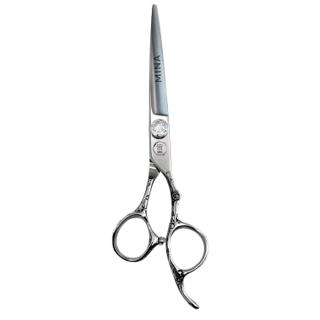
Backup cutter, 5.0″ to 7.0″
Mina Sakura II Hair Cutting Scissors
In stock: 5.0″, 5.5″, 6.0″, 6.5″, 7.0″
If the old pair is past saving, the top barber scissors in Australia and how to choose barber scissors help you pick the replacement, or browse cutting shears.
Questions
How do I know if my barber scissors are blunt?
Hair pushes along the blade instead of cutting, folds at the tips, or snags in one spot. Clean the pivot and check tension first. If the shear still pushes or folds hair with tension set right, the edge is dull.
Why do my scissors fold hair?
Usually loose tension, a dull edge near the tips, or a right-handed shear used in the left hand. Check tension with the drop test, then the tips. A lefty needs a true left-handed shear.
Can I test scissors on paper?
No. Paper dulls a hair-cutting edge and tells you little about how it cuts hair. Use a damp tissue or a wet hair section, which is a standard sharpener's check.
Can tightening the screw fix blunt scissors?
No. Tension holds the blades together; it cannot sharpen them. Over-tightening a dull shear makes the action drag and wears the ride line. Set tension right, then sharpen if it still pushes hair.
Is it worth sharpening cheap scissors?
Usually yes for a decent 440C cutter, which sharpens well. If a training pair has a bent tip or damaged ride line, compare the service quote with a new cutter.