10 Japanese vs German Scissor Myths
Quick answer
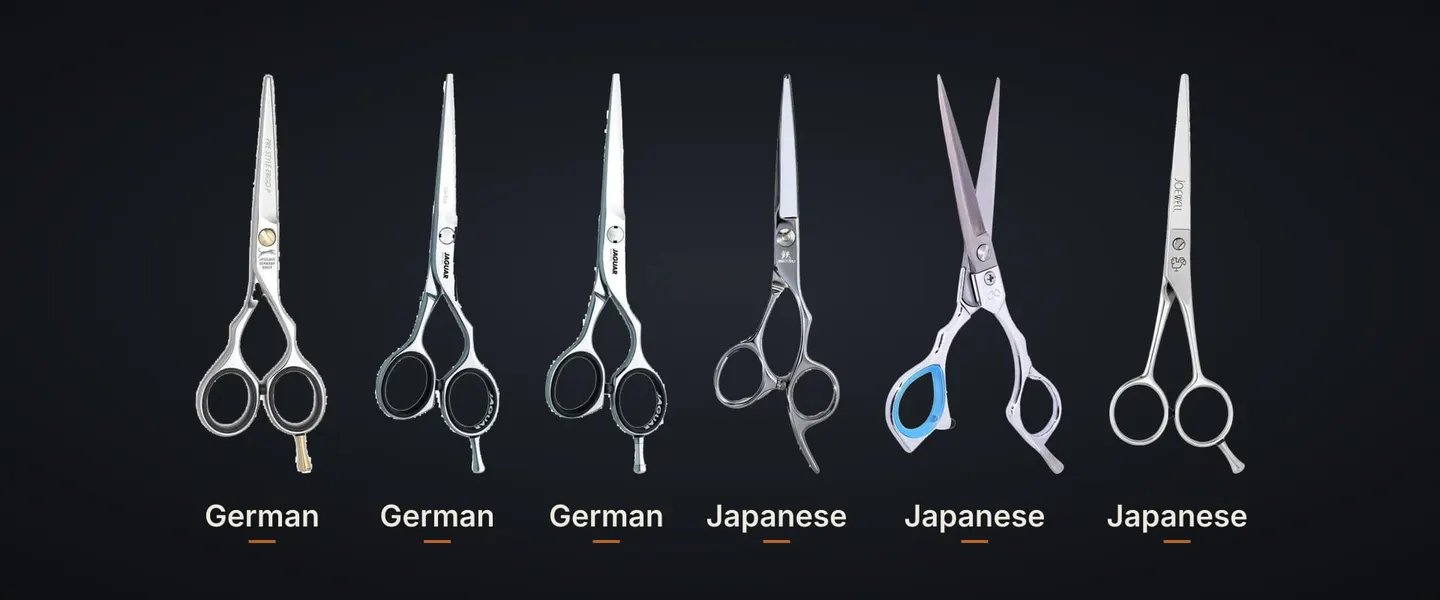
Most Japanese versus German scissor myths fall over on the spec sheet. Country does not decide sharpness, edge shape, handle, price or skill level. Edge, steel, handle and length do. Japanese brands lean to convex edges and offset handles; German-made Jaguar leans to micro-serrated blades and classic handles, with convex at the top of its range.
Japanese or German is the first question most buyers ask, and it is the least useful one. The flag on the box describes where a brand sits, not how a shear cuts. This list takes ten common claims and checks them against the things that do decide the cut.
How this list was chosen: each myth is a claim barbers repeat about Japanese and German scissors, checked against product files, maker pages and our own comparison. Where the answer is a tendency, it says so. Reviewed 4 November 2026. For the full side-by-side, read Japanese vs German barber scissors.
The ten myths at a glance
Scroll sideways to compare all columns.
| # | Myth | What is true |
|---|---|---|
| 1 | Japanese is always sharper | The edge decides, not the country |
| 2 | Japanese steel means made in Japan | Steel and factory are separate facts |
| 3 | German is for beginners | Jaguar runs entry to premium |
| 4 | Higher HRC is better | Hardness is one property |
| 5 | Only Japanese scissors are convex | Jaguar makes convex too |
| 6 | Japanese is offset, German is classic | Both make several handles |
| 7 | A Japanese brand name proves the origin | A brand is not a factory |
| 8 | You must pick a side | Keep one of each if you cut both ways |
| 9 | Price shows which country wins | Both span entry to premium |
| 10 | Over-comb needs Japanese steel | Length matters more |
1. Myth: Japanese scissors are always sharper
Sharpness comes from the edge shape, the blade set and the care a pair gets, not from a flag. A fine convex edge that is dropped or left wet cuts worse than a plain bevel that is looked after. Judge a pair by how it cuts after it is clean and set.
The blunt scissors tests check any pair the same way, whatever the origin.
2. Myth: Japanese steel means made in Japan
Steel provenance and manufacturing location answer different questions. A steel can be Japanese-grade and the shear finished elsewhere, and a listing can name one without the other. Report each only when the product supports it.
Kamisori is a Canadian brand with Japanese-inspired designs; some models are made in Japan. Its brand page sets out the range.
3. Myth: German scissors are for beginners
Jaguar’s German-made range starts at entry-level Pre Style and White Line and climbs through Silver Line to Gold Line vanadium cutters with convex blades. Premium is in the range. The Japanese side has its own entry rung in Mina.
Neither country owns a price tier. The Jaguar brand page shows the steps.
4. Myth: a higher HRC means better scissors
HRC is hardness on the Rockwell C scale. It is one property, and it does not score sharpness, comfort or how long a pair lasts. Japanese brands list a figure and Jaguar names the steel instead, so the two are not directly comparable.
The steel guide explains what the numbers can tell you, and the VG10, 440C and ATS314 comparison reads them side by side.
5. Myth: only Japanese scissors have a convex edge
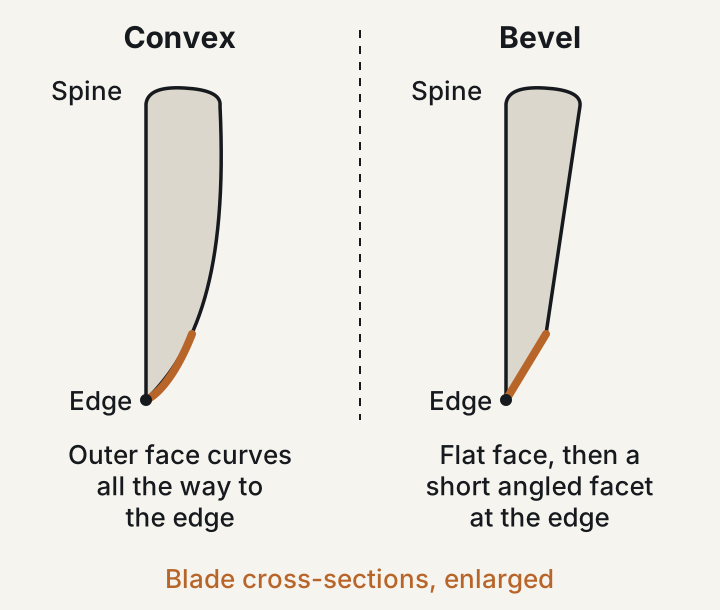
Jaguar’s Gold Line runs a convex edge, and its Silver Line is semi-convex. Joewell’s blade guide describes its Standard blade as a flat single bevel, so a Japanese maker can sell a bevel edge too. The country does not fix the edge.
The convex vs bevel guide shows both in cross-section.
6. Myth: Japanese scissors are offset and German ones are classic
The Japanese cutters we stock are mostly offset, but Joewell, Yasaka and Juntetsu all make level-ring options. Jaguar covers classic, offset and crane handles across its lines. Handle choice follows your hold, not the maker’s address.
Compare layouts in the handle guide, or browse classic-handle and offset-handle shears.
7. Myth: a Japanese brand name proves where it was made
A brand’s national identity does not identify the steel or the factory. Mina, Ichiro and Juntetsu are independent Japanese brands, Yasaka and Joewell are Japanese makers, and Jaguar is German-made. That is what the product files and brand pages say, and the claims stop there.
Read the origin line on the product page, not the logo. The brand map lists every brand we stock.
8. Myth: you have to pick a side
You can keep both. A micro-serrated edge grips hair, which helps in blunt cutting and over the comb. A convex edge slices, which suits point and slide cutting. If you do both in a day, you may want one of each.
Start with the job. The scissor blades post compares the edges.
9. Myth: price shows which country wins
Both sides run from entry to premium. Jaguar goes from Pre Style to Gold Line; the Japanese brands go from Mina to Juntetsu and Yasaka. Price tells you the tier, not the flag.
Compare by spec within your budget. The budget list and the premium list show both ends.
10. Myth: scissor-over-comb needs Japanese steel
Over-comb work wants length: 6.5″ or 7.0″ to span more of the comb. Both sides have long options, and a micro-serrated German blade holds hair still off the comb while a convex Japanese blade slices through it. Either works.
Match the length first. The long scissors list compares both, and the scissor-over-comb tips cover technique.
What would change this list
If you cut dry, slide cut and point cut most of the day, the convex end of the table matters most. If you cut blunt lines over the comb and want a gripping blade, the micro-serrated end does. When you have narrowed to a brand, read the verdict posts: are Jaguar scissors good and are Yasaka scissors good.
Pick by career stage
- Apprentice: ignore the flag. Match the handle your trainer uses and a 5.5″ or 6.0″ length.
- Working barber: pick the edge for your technique, then the country if two pairs tie.
- Upgrade: compare steel, edge and handle across both countries before you choose a premium pair.
Browse Jaguar, Yasaka and Juntetsu, or start from the complete buying guide.
Further reading: for wider scissor background, see Scissorpedia. Scissorpedia is a fellow member of the ShearAlliance (see ShearAlliance).
More plain-English comparisons are in the knowledge base.
Questions
Are Japanese barber scissors better than German ones?
Neither is better by origin. They tend to differ: Japanese brands we stock lean to convex edges and offset handles, and German-made Jaguar leans to micro-serrated blades and classic handles. Pick by edge, handle and length for the work you do.
Is Jaguar a Japanese brand?
No. Jaguar is a German maker and every Jaguar shear we stock is German-made. Mina, Ichiro and Juntetsu are independent Japanese brands, and Yasaka and Joewell are Japanese makers.
Does Japanese steel mean the scissors are made in Japan?
Not necessarily. Where the steel comes from and where the shear is made are separate facts. Kamisori, for example, is a Canadian brand with Japanese-inspired designs, and some models are made in Japan.
Can I own both a Japanese and a German pair?
Yes. Some barbers keep a micro-serrated pair for blunt lines and over-comb work and a convex pair for slide and point cutting. Choose each by the job it does.